Article Overview
This article documents the complete 27-day process of manufacturing and exporting a 1250kVA, 10.5kV/0.42kV epoxy cast resin dry-type transformer to Europe, covering EU energy efficiency regulation (EU No 548/2014) compliance, CE Declaration of Conformity, Factory Acceptance Test (FAT) procedures, and critical lessons learned from aligning with international standards. Whether you’re sourcing medium-voltage dry-type transformers (6kV-35kV) or planning large-capacity installations (30kVA-6300kVA), this real-world experience provides actionable insights for international dry-type transformer projects.
March 12, 2025, Wednesday, 9:30 AM. I stood in the production workshop, watching the winding machine slowly come to a halt. The client’s supervising engineer came straight to the factory after landing, and his first words were: “We need to talk about standards.”
That 1250kVA, 10.5kV/0.42kV cast resin dry-type transformer—all materials were in place, the production schedule was posted on the wall, and every process milestone was planned. But now, everything had to pause.
As a manufacturer specializing in medium and high-voltage dry-type transformers, our product line covers the complete series from 30kVA to 6300kVA capacity, supporting 6kV, 10kV, and 35kV high-voltage inputs, serving multiple sectors including industrial distribution, renewable energy, data centers, and more. Our experience ranges from large-scale hospital projects with over 10MVA total dry-type transformer capacity to specialized installations. But this European export project taught us what “international standards” truly means—quite different from our previous domestic projects like the 63MVA 110kV OLTC transformer installation.
I. Standards Are More Than Just Numbers
“Your design proposal has a gap with our energy efficiency requirements.” The engineer opened his laptop, displaying an EU regulation document—COMMISSION REGULATION (EU) No 548/2014.
Our team exchanged puzzled looks. After years in the dry-type transformer business, we knew Chinese national standards inside out. Whether it’s 630kVA, 1000kVA medium-capacity cast resin dry-type transformers or 2500kVA, 3150kVA large-capacity epoxy resin dry-type units, we have mature design solutions. But this EU energy efficiency regulation was new to most of us.
Later I learned this regulation had been amended in 2019. Our design, based on conventional approaches, simply couldn’t meet EU Tier 1 energy efficiency requirements for no-load losses.
That afternoon’s meeting was grueling. The technical director, production supervisor, quality manager, and I gathered around the conference table. The whiteboard filled with calculation formulas:
- Should we change the silicon steel grade?
- How to optimize the core cross-sectional area?
- Can we optimize the winding turns?
The most practical issue: We hadn’t received the client’s technical specification document beforehand. We designed based on conventional thinking for dry-type transformers, but now aligning with international standards meant rethinking many aspects.
This situation is particularly prominent in 10kV voltage class dry-type transformers. Compared to our commonly produced 6kV industrial dry-type transformers, 10kV systems have stricter requirements for insulation margins and energy efficiency—something we’ve learned from various projects including our oil-immersed transformer portfolio where voltage classes vary significantly.
II. Those “Unexpected” Requirements
The supervising engineer spent three days in the workshop, filling over twenty pages of notes. Some requirements we’d truly never encountered before in dry-type transformer manufacturing.
About Bolt Torque Specifications
“All electrical connection bolts must have marked tightening torque values,” he said, pointing at the high-voltage terminal. “You can’t rely on feel—it must follow standards.”
We used to have experienced masters tighten by instinct. Now we needed standards: M12 connection bolts controlled at 45-50N·m torque, clearly documented in the maintenance manual.
This requirement applies not only to this 1250kVA unit but made us realize: from small-capacity 100kVA, 200kVA dry-type distribution transformers to large-capacity 4000kVA, 5000kVA dry-type power transformers, every connection point requires such precise control.
About High-Temperature Resistant Marking Materials
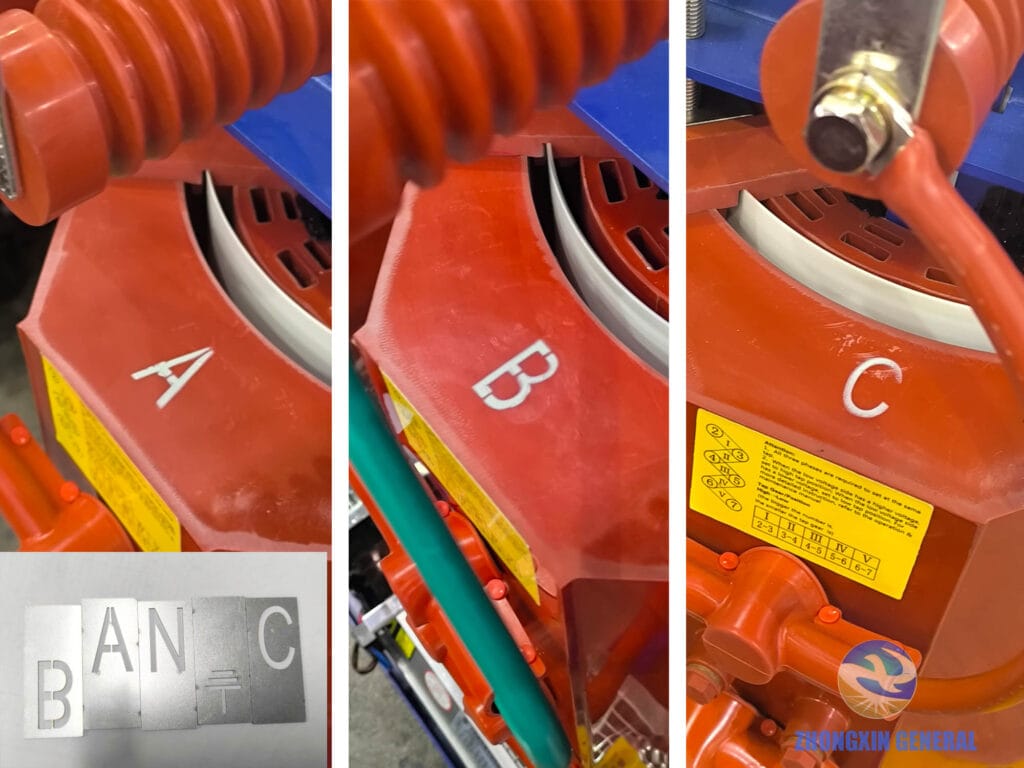
Initially, we used metal steel plates for phase sequence markings per domestic practice, but the client rejected it due to European safety regulations. We then suggested printed stickers—convenient and cheap.
“When the cast resin dry-type transformer operates, hot-spot temperatures reach 140℃,” the engineer shook his head. “Can ordinary stickers withstand that?”
Later we made molds and completed phase markings with special high-temperature resistant coatings—a solution now applied across our complete dry-type transformer product line.
About Current Transformer (CT) Installation Position
During design, we placed the CT in a seemingly reasonable position. On assembly day, we discovered insufficient installation space.
The technical director later explained: “The main neutral busbar is a busbar with excessive current—installing the CT here isn’t appropriate. We need to extend a section from the main neutral busbar and install the CT on the extension.”
This issue even required adjusting the client’s schedule.
III. Trust Across Oceans

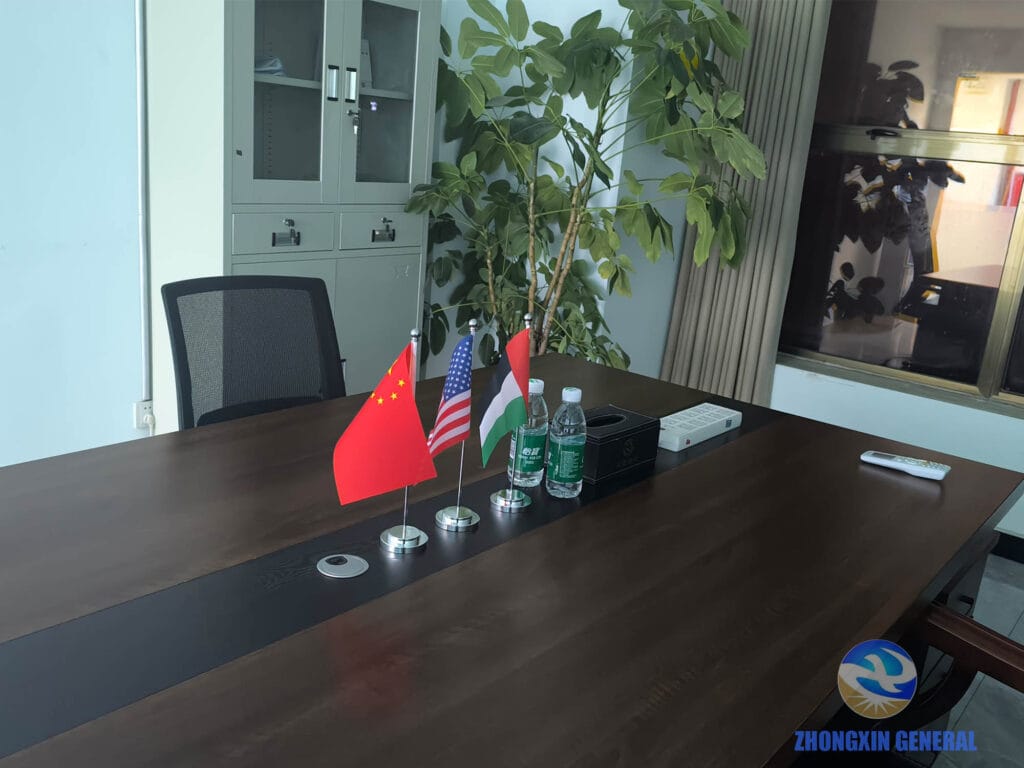
On March 15, I drove to Chengdu Tianfu International Airport to pick up the client, the president of an EPC company from UAE and his company was sourcing for a European Project. This was his first visit to China and the first on-site inspection of our dry-type transformer factory.
On the way, we discussed production capacity. He mentioned that the European market has significant demand for 35kV voltage class medium cast resin dry-type transformers (800-2000kVA) and asked if we had batch production capabilities.
I told him our production lines can cover the complete series from 30kVA to 6300kVA capacity, with mature manufacturing processes for 6kV, 10kV, and 35kV voltage classes. Particularly in the 1000-2500kVA capacity range for dry-type transformers, these are our flagship products—similar to the equipment we supplied for our major hospital electrification project. He was very interested and said if this dry-type transformer project went smoothly, he would consider more cooperation opportunities.
IV. Documents, Documents, and More Documents
If technical requirements could be solved somehow, documentation requirements were truly a new challenge for our dry-type transformer export project.
Understanding ITP (Inspection and Test Plan)
We’d heard of ITP (Inspection and Test Plan) but never formally implemented one for dry-type transformer projects. The production department gave me several different files—inconsistent formats and content.
ITP is essentially a detailed quality control roadmap that specifies which manufacturing stages require inspection, who performs them, and whether client approval is needed before proceeding. For dry-type transformers, this typically includes raw material inspection, winding process verification, core assembly checks, and final testing validation.
Finally, the client sent us a template, which we followed. From raw material arrival to finished dry-type transformer shipment, we set over ten inspection points, clearly marking which required client hold points and which only needed notification.
Download our ITP template for dry-type transformer projects – based on international best practices and refined through this project.
Mastering FAT (Factory Acceptance Test) Requirements
The FAT (Factory Acceptance Test) report was another challenge.
FAT is a comprehensive testing protocol conducted before shipment, where the client verifies that the dry-type transformer meets all contractual specifications. It differs from routine factory testing by requiring detailed documentation, witness points, and formal acceptance signatures.
Our usual factory reports for dry-type transformers were simple, but the client’s FAT report requirements included:
- Core grounding resistance test (previously not tested)
- Fan and temperature control linkage test
- Complete temperature rise data recording
- Noise level measurements at specified distances
- Insulation resistance verification
On test day, the engineer came with data: “Original records don’t match the report template.” The original records showed actual measured values, but the report required converted standard values—a correction coefficient was missing.
We revised until after 9 PM that day.
Download sample FAT report template – complete with all required test parameters for medium-voltage dry-type transformers.
V. The Devil’s in the Details
As the dry-type transformer project progressed, small issues multiplied—many of which we’d never encountered in our oil-immersed transformer projects.
Cable Length Specifications
During final assembly, we discovered the temperature control and fan cable lengths weren’t confirmed. We didn’t know the client’s site installation conditions—cables too short couldn’t be installed; too long wasted material.
After repeated communication, we confirmed 12 meters—normally 1.5 meters suffices for domestic installations.
This experience was later applied to other dry-type transformer projects. Whether 315kVA small dry-type distribution transformers or 6300kVA large dry-type power transformers, we now clarify cable length requirements during contract review.
Two-Crate Packaging Solution
I initially thought one wooden crate for the entire dry-type transformer would work. At the workshop, I saw cooling fans already installed on top—forcing it into one crate would surely damage them during transport.
We split into two crates: one for the dry-type transformer body, one specifically for fans and accessories. This became our standard for all medium to large capacity cast resin transformers destined for international markets.
Phase Marking Optimization
To meet stringent safety requirements, we abandoned sharp metal plates. Instead, we laser-cut letter stencils and applied high-temperature resistant paint to create permanent, legible phase markings directly on the transformer. This custom solution ensured safety, durability, and full compliance with client specifications.
VI. The Truth About Testing
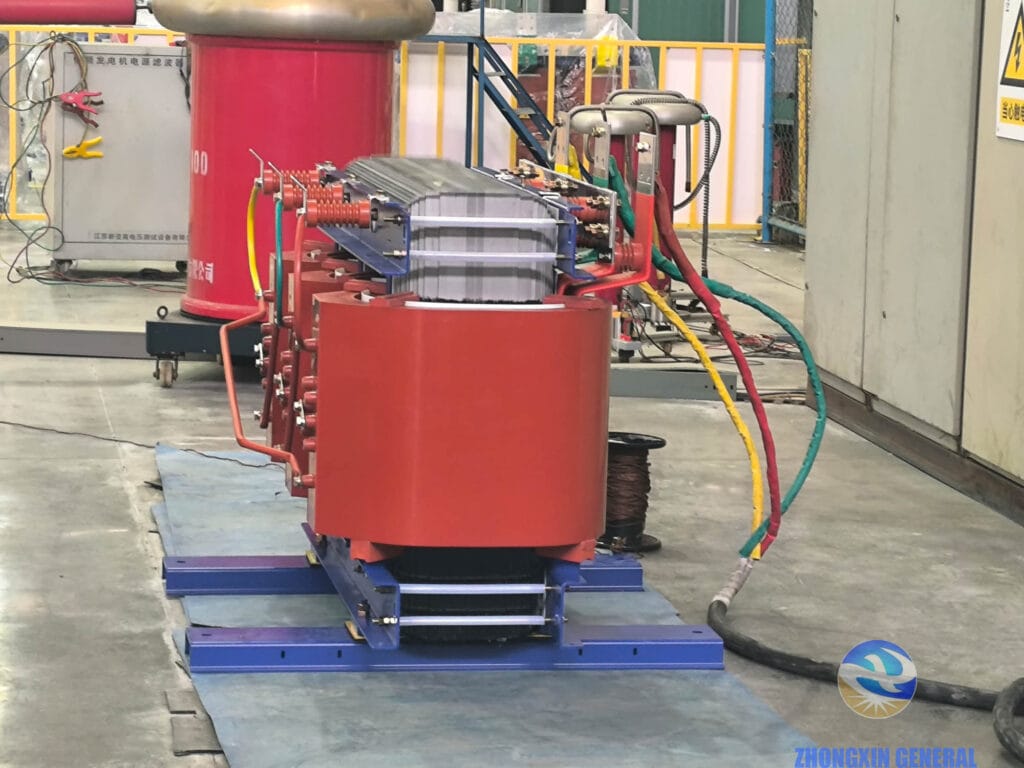
On March 18, testing finally began.
No-Load Loss Test: The Energy Efficiency Moment
The no-load loss test was the first hurdle. This 1250kVA, 10kV class dry-type transformer had to achieve EU Tier 1 energy efficiency with no-load losses below 2.6kW. Our design value was 2.45kW, providing some margin.
The test engineer started the equipment, and data began fluctuating. Everyone stared at the screen, not daring to breathe.
Final result: 2.38kW. Passed!
Comprehensive Testing Protocol
Next came:
- Load loss testing – verifying copper losses under rated current
- Temperature rise test – ensuring hot-spot temperatures stay within limits
- Noise level measurement – meeting European environmental standards
- Partial discharge testing – critical for cast resin insulation integrity
Every item was executed strictly according to the ITP plan.
The client’s engineer observed and recorded throughout. He said this testing procedure was the most standardized he’d seen among Asian dry-type transformer suppliers.
He also mentioned that if we maintain this standard, future orders for 500kVA, 800kVA, 1600kVA medium-capacity dry-type transformers, as well as 35kV voltage class special dry-type transformer projects, could all be considered for cooperation.
VII. The Certification Choice
For dry-type transformers shipped to Europe, CE certification was a practical issue that had to be addressed.
Understanding CE Certification Options
The supervising engineer initially said: “If complete third-party CE certification is needed, the client can negotiate covering the cost.” We learned that TUV’s CE certification for a dry-type transformer energy efficiency project individually costs around €4,000-5,000 (approximately 40,000-50,000 RMB).
CE Declaration of Conformity (DOC) Approach
After communication, the client’s compliance team suggested using a CE Declaration of Conformity (DOC).
CE DOC is a manufacturer’s self-declaration that the product meets relevant EU directives and harmonized standards. Unlike third-party certification, it requires the manufacturer to maintain comprehensive technical documentation proving compliance but doesn’t require external testing if the manufacturer has adequate quality systems.
For our dry-type transformer, this meant documenting:
- Compliance with Low Voltage Directive (LVD) 2014/35/EU
- Conformity to EU No 548/2014 energy efficiency regulation
- Adherence to IEC 60076 transformer standards
- EMC compatibility verification
- Complete technical file including design calculations, material certificates, and test reports
We referenced the client’s template and spent another weekend completing this declaration—download our CE DOC template for dry-type transformers here.
This process established our complete CE certification knowledge system, applicable not only to 10kV voltage class dry-type transformers but also to 6kV industrial dry-type transformers and 35kV dry-type power transformers.
VIII. The Product’s Final Journey
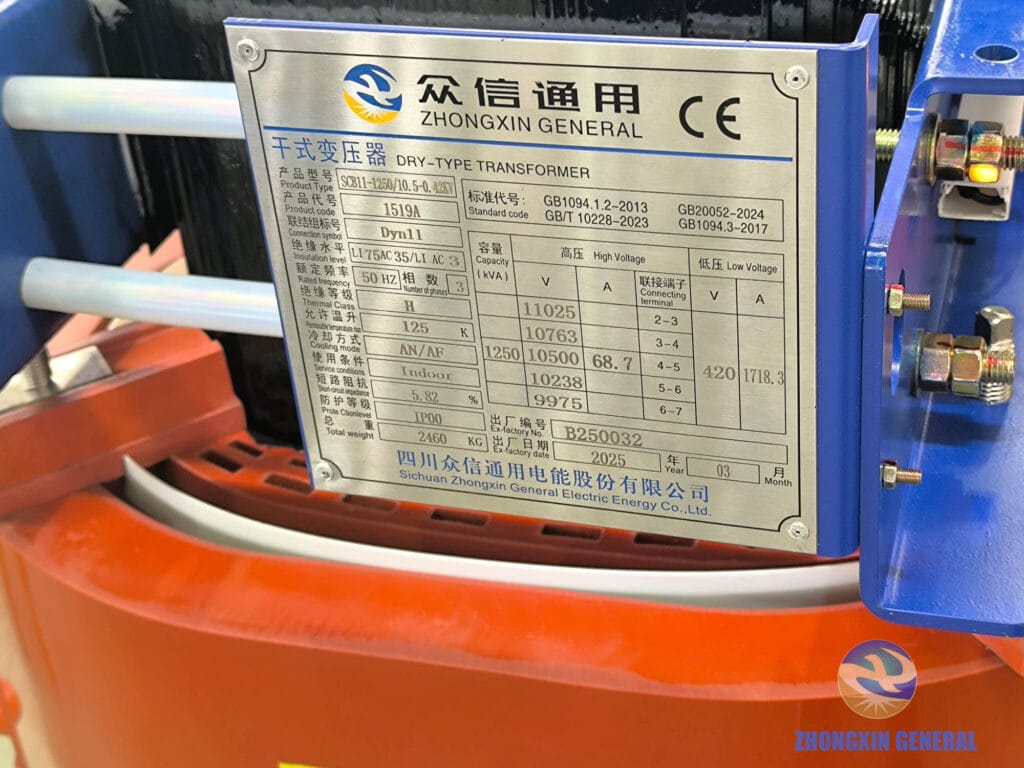
On April 3, the cast resin dry-type transformer was finally completed.
Technical Specifications on Nameplate
The nameplate clearly indicated:
- Rated Capacity: 1250kVA
- High Voltage: 10.5kV
- Low Voltage: 0.42kV
- Insulation Class: H (175°C)
- Cooling Method: AN (Air Natural) / AF (Air Forced)
- Compliance Standards: GB1094.1.2-2013 GB/T 10228-2023 GB20052-2024 GB1094.3-2017
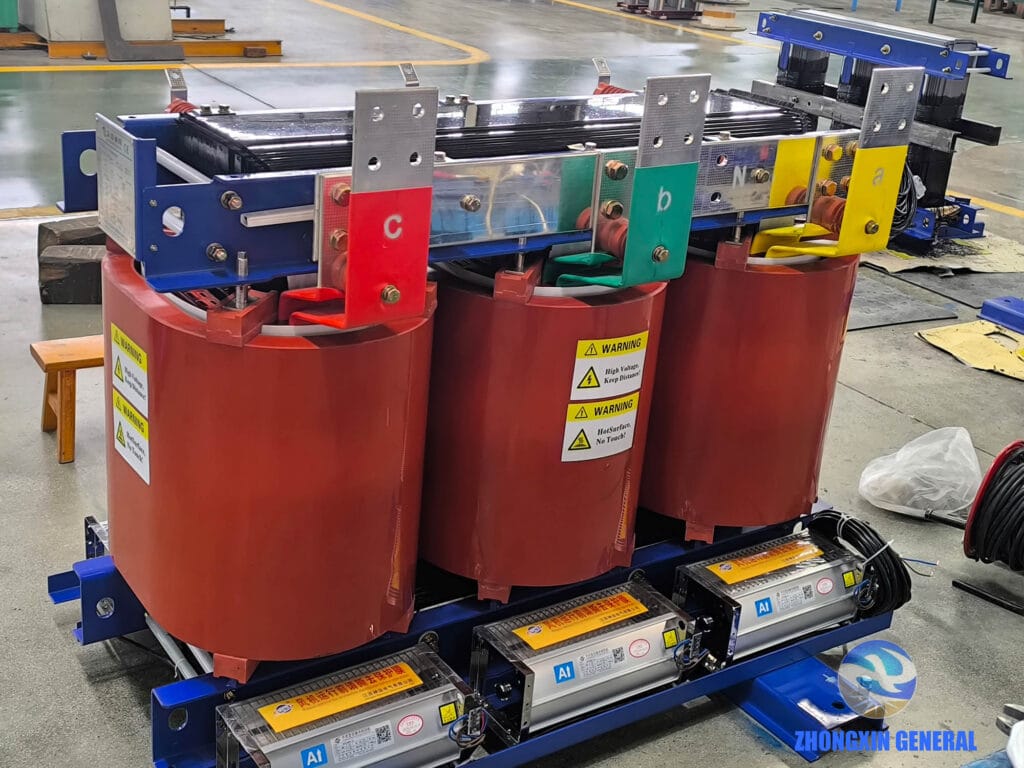
The entire dry-type transformer unit stood in the workshop—everyone breathed a sigh of relief.
Pre-Shipment Quality Control
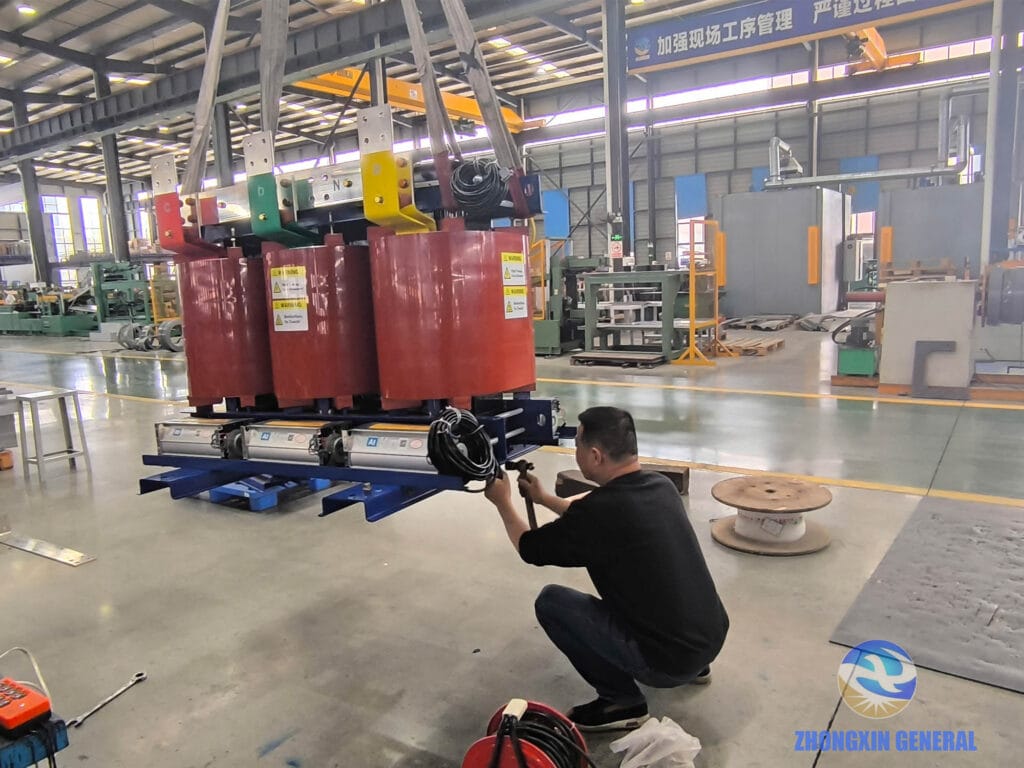
The quality department conducted one last comprehensive inspection:
- All bolt torque values verified with calibrated torque wrenches
- Electrical connection points checked for proper contact
- Phase sequence markings confirmed visible and durable
- Documentation package reviewed: test reports, certificates, manuals, CE DOC
- Protective coatings inspected for complete coverage
Export-Grade Packaging
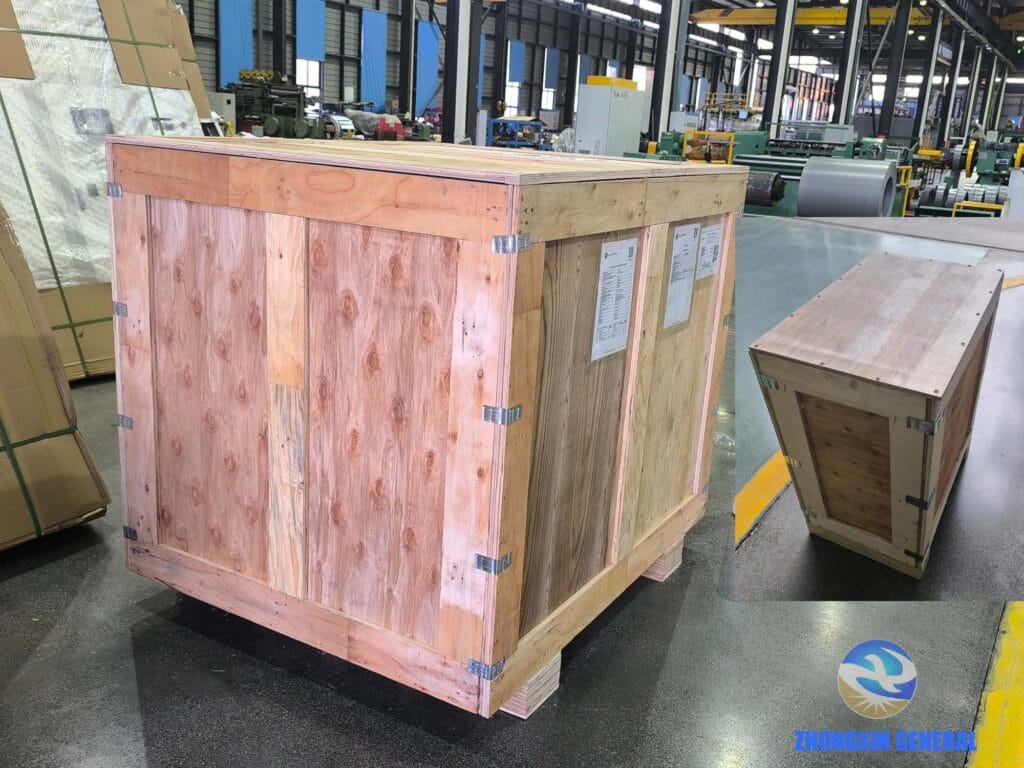
After packaging, the dry-type transformer was secured in custom wooden crates meeting ISPM 15 international standards. This two-crate packaging solution later became our standard procedure for exporting 630kVA-3150kVA medium to large dry-type transformers.
Packaging specifications:
- Main transformer body: reinforced wooden crate with internal shock absorption
- Cooling fans and accessories: separate protective crate
- Desiccant packets to prevent moisture during transit
- Tilt indicators and fragile handling labels
- Complete documentation package in waterproof sleeve
IX. The Client’s Words
On the afternoon of March 19, all tests finally passed. The client and I stood in the workshop, looking at that dry-type transformer, my heart filled with mixed emotions.
He patted my shoulder: “You know what? If I had someone like you on my team, my business would grow at least tenfold.”
I was stunned, speechless, but deeply felt the client’s recognition.
He continued: “I’ve seen too many dry-type transformer suppliers across Asia and Europe. When problems arise, they make excuses; when difficulties come, they want to quit. But you’re different—you genuinely solve problems. This sense of responsibility, this persistence, is more precious than any technical ability.”
“Remember this feeling today. In the future, no matter how difficult the dry-type transformer project, you can tell yourself: I’ve handled top-tier European standards—what else can defeat me?”
Future Opportunities
He also mentioned having several 35kV substation renovation projects in Northern Europe requiring 2000-3150kVA capacity dry-type transformers, asking if we were interested in quoting. These projects would involve similar stringent requirements but with even larger capacities.
This conversation reminded me of the trust we’d built on our hospital dry-type transformer project where multiple units worked in parallel—reliability at scale.
X. Journey to Europe
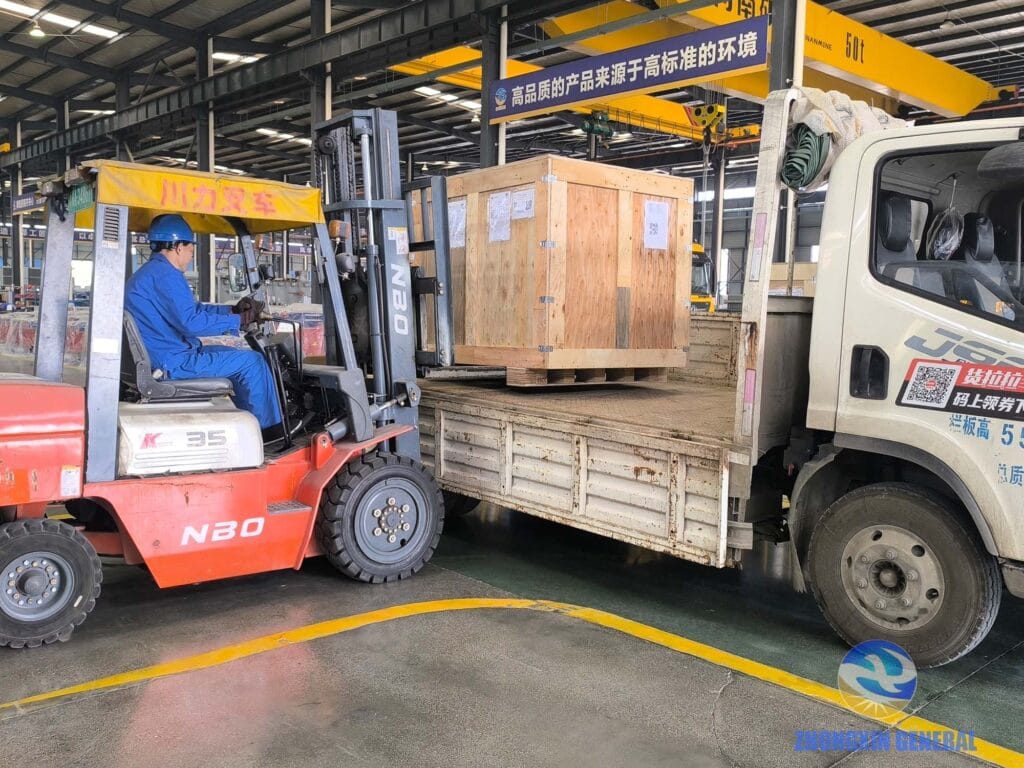
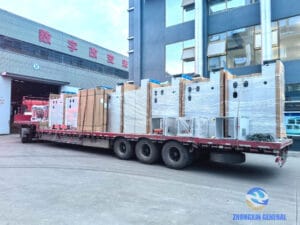
At 10 AM on April 8, the truck headed to Chengdu Shuangliu International Airport.
This 1250kVA, 10kV/0.4kV cast resin dry-type transformer would be air-freighted directly to Europe via a major European cargo hub, which is a rare shipping method for a power transformer. From order receipt to shipment, exactly 27 days—a timeline that demonstrated our capability to meet urgent international project schedules.
Logistics Details
Shipping specifications:
- Total weight: approximately 2700 kg (transformer) + 80 kg (accessories)
- Dimensions: Main crate 2.4m × 1.8m × 2.1m
- Air freight route: Chengdu → Frankfurt → Final destination
- Transit time: 5-7 days door-to-door
- Insurance: Full coverage for transportation and installation
Watching the forklift load two large wooden crates onto pallets, I suddenly realized: this wasn’t just a dry-type transformer’s journey, but evidence of our entire team’s capability to compete in the demanding European market.
XI. The Process Is More Precious Than the Result
During those twenty-seven days, the entire team operated at overload capacity, but the transformation was remarkable.
Standards Awareness Transformation
We used to think “close enough is fine”—now we know what “precise positioning” means. International clients’ dry-type transformer requirements aren’t nitpicking but quality baselines that protect end-users and ensure decades of reliable operation.
Whether small-capacity 50kVA, 80kVA dry-type distribution transformers or large-capacity 4000kVA, 5000kVA, 6300kVA dry-type power transformers, every detail now requires the same rigor we applied to this European project.
Document System Establishment
We created complete ITP and FAT file templates for dry-type transformer projects. Future projects can use them directly—experience money can’t buy.
This documentation system now applies to our 6kV, 10kV, 35kV complete series dry-type transformer production management, and even influences our oil-immersed transformer quality protocols.
Team Capability Enhancement
- Technical staff now read international dry-type transformer standard documents fluently
- Workers using calibrated torque wrenches became standard practice
- Quality departments fully understand traceability requirements
- Production planning incorporates international witness point schedules
Product Line Refinement
Through this dry-type transformer project, we systematically organized:
- 30-200kVA small-capacity dry-type distribution transformer standardized production processes
- 315-1600kVA medium-capacity industrial dry-type transformer quality control points
- 2000-6300kVA large-capacity dry-type power transformer testing and acceptance specifications
- Technical requirement differences for 6kV, 10kV, 35kV different voltage class dry-type transformers
Most Importantly: Confidence
Having handled such stringent dry-type transformer requirements for the European market, we now approach every project—from large-scale hospital installations to high-voltage OLTC transformer projects—with proven international capabilities.
XII. In Closing
Looking back now, that 1250kVA cast resin dry-type transformer wasn’t a high value project itself, but through dealing with global industry leaders and meeting European regulatory standards, what we learned far exceeded technical matters.
Key Takeaways for International Dry-Type Transformer Projects
It taught us: High-end markets recognize not just dry-type transformer products but a complete, reliable capability system. From design to production, from testing to documentation, every link must withstand the scrutiny of international standards.
Client trust accumulates through details:
- A bolt’s precise torque value (45-50N·m for M12)
- A cable’s confirmed length (12 meters vs. standard 1.5m)
- A test report’s accuracy and traceability
- A CE declaration’s comprehensive technical backing
- Packaging that ensures zero-damage delivery
The Beginning, Not the End
When the dry-type transformer project ended, the client said: “This is just the beginning.”
I knew what he meant. Having passed the strictest European inspection, we’ve opened doors to broader international markets.
Whether small 100kVA, 200kVA dry-type distribution equipment or large 3150kVA, 4000kVA, 6300kVA dry-type power transformers; whether 6kV industrial applications or 10kV, 35kV power system dry-type transformers—we’re now confident in providing products and services meeting international standards including EU energy efficiency regulations, IEC specifications, and CE compliance.
This inspection had no standard answers—only solutions continuously refined through practice. Every step we’ve taken becomes a reference for those who follow—perhaps that’s the greatest significance of technical sharing.
About Our Dry-Type Transformer Manufacturing Capabilities
Complete Product Range
Capacity Range: 30kVA – 6300kVA Complete Series Cast Resin Dry-Type Transformers
Voltage Classes:
- 6kV dry-type transformers – Industrial distribution, manufacturing facilities
- 10kV dry-type transformers – Commercial buildings, renewable energy
- 35kV dry-type transformers – Substations, large industrial complexes
Application Fields
- Industrial power distribution
- Renewable energy projects (solar, wind farms)
- Data centers and IT facilities
- Rail transit systems
- Commercial and residential buildings
- Hospital and healthcare facilities – See our major hospital project case study
- Mining and heavy industry
International Certifications & Standards
- IEC 60076-11 2018 – Power transformers -Part 11: Dry-type transformers
- GB/T 10228 – Specification and technical requirementsfor dry-type power transformers
- GB/T 1094.11 2022 Power transformers-Part 11: Dry-type transformers
- EU No 548/2014 – European Energy Efficiency Regulation-COMMISSION REGULATION (EU) No 548/2014 of 21 May 2014 on implementing Directive 2009/125/EC of the European Parliament and of the Council withregard to small, medium and large power transformers (OJ L 152, 22.5.2014, p. 1)
- CE Declaration of Conformity – European Market Access
- ISO 9001 – Quality Management System
- ISO 14001 – Environmental Management
Why Choose Our Dry-Type Transformers?
Proven European Export Experience – Successfully delivered to demanding EU markets
Complete FAT & ITP Documentation – International-standard quality protocols
Energy Efficiency Compliance – EU Tier 1 certified designs available
Flexible Customization – Voltage, capacity, and enclosure options
Fast Delivery – 27-day turnaround demonstrated on urgent projects
Comprehensive Support – From design consultation to after-sales service
Ready to Discuss Your Dry-Type Transformer Project?
Whether you need a single 500kVA unit or a complete substation with multiple 3000kVA+ dry-type transformers, our team is ready to support your project with international-standard quality and documentation.
Get Your Custom Quote Today
Contact us for:
- Technical specifications consultation
- Energy efficiency compliance verification
- Custom voltage and capacity configurations
- CE certification support
- Project timeline and delivery planning
- FAT witness arrangements
📧 Email: [[email protected]]
📞 Phone: [+86-135-4008-9818]
🌐 Website: [www.zxtransformer.com]
💬 WhatsApp: [+86-135-4008-9818]
Download Free Technical Resources
📄 ITP Template for Dry-Type Transformers – International quality control roadmap
📄 FAT Report Sample – Complete testing documentation example
📄 CE Declaration of Conformity Template – European compliance document
📄 Product Catalog– Capacity and voltage class reference
Related Case Studies & Resources
🔗 10+ Units Hospital Dry-Type Transformer Project (>10MVA Total) – Large-scale healthcare facility electrification
🔗63MVA 110kV OLTC Transformer Installation – High-voltage power distribution project
🔗 Complete Dry-Type Transformer Product Line – 30kVA to 6300kVA specifications
🔗 Oil-Immersed Transformer Solutions – Alternative technology comparison
This article is compiled from a real dry-type transformer export project completed in March-April 2025. To protect commercial privacy, client and company names have been anonymized. All technical details, standards, and procedures are authentic and provided for industry reference. Specific implementation should always consider your unique project requirements and local regulations.
At an appropriate time, with client consent, we plan to share additional insights from this landmark dry-type transformer project, including detailed energy efficiency calculation methods, advanced testing protocols, and lessons learned from European market entry.