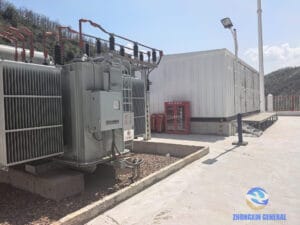
Project Snapshot
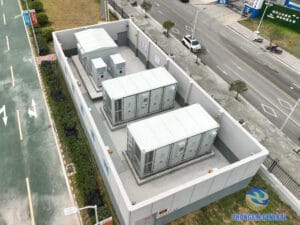
| Product | Prefabricated Cabin-Type Integrated Substation (Modular) |
| Overall Dimensions | 15 m (L) × 10.5 m (W) × 3.7 m (H) |
| Transport Modules | 5 (3 × 3.2 m wide + 2 × 2.7 m wide, each 10.5 m × 3.7 m) |
| High-Voltage Switchgear | 14 × KYN28-12 Air-Insulated Metal-Clad Withdrawable Switchgear |
| Transformers | 2 × 800 kVA ZHONGXIN GENERAL Dry-Type (own manufacture) |
| Low-Voltage Switchgear | 12 × Withdrawable LV Distribution Panels |
| Control System | Integrated DC/AC panel, RTU, rear-end monitoring unit, fire control, UPS |
| End Client | Aktau Container Hub, Kazakhstan |
| Application | Primary power core for container transhipment, inspection & hazmat handling |
| Delivery Route | Xingjin (Chengdu) → Xinjiang → Horgos Border Port → Aktau, Kazakhstan |
| Delivery Distance | ~4,500 km overland |
| Dispatch Date | September 2025 |
| Manufactured by | Zhongxin General Electric Energy Co., Ltd. (四川众信通用电能股份有限公司) |
| Manufactured in | Xingjin Economic Development Zone, Chengdu, Sichuan, China |
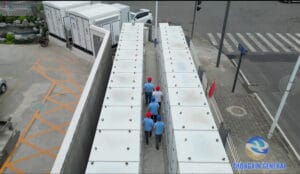
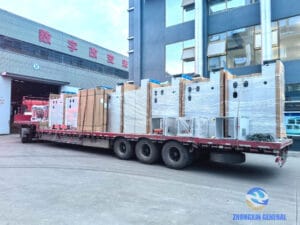
Dispatch day at Zhongxin General’s Chengdu facility: aerial footage of the five 17.5-metre flatbed convoys loading and departing for Kazakhstan, plus an interview with General Manager Zhang Shaokuan — filmed by Chengdu Daily.
Background: Powering a Belt & Road Gateway on the Caspian Sea
Aktau Port, on Kazakhstan’s Caspian Sea coast, is one of the most strategically significant nodes on the Trans-Caspian International Transport Route — the sea link that allows China–Europe freight trains to bridge Central Asia across the Caspian. The port’s container hub handles the cargo transfer, customs inspection, and hazardous goods processing that keeps the Trans-Caspian corridor moving.
When the Aktau container hub expansion required a new, dedicated power core capable of meeting the full electrical load of the terminal’s operations, Zhongxin General Electric Energy Co., Ltd. — a Chengdu-based manufacturer of power transformers, switchgear, and prefabricated substations — was selected to engineer and deliver a purpose-built solution.
The challenge was not merely electrical. A substation measuring 15 metres long, 10.5 metres wide, and 3.7 metres tall — three times the volume of a standard shipping container — cannot travel 4,500 kilometres overland as a single unit. Delivering “Made in Chengdu” power infrastructure to the Caspian coast required an engineering solution that addressed transport physics as rigorously as it addressed electrical performance.
The Engineering Challenge: Size, Distance, and Border Compliance
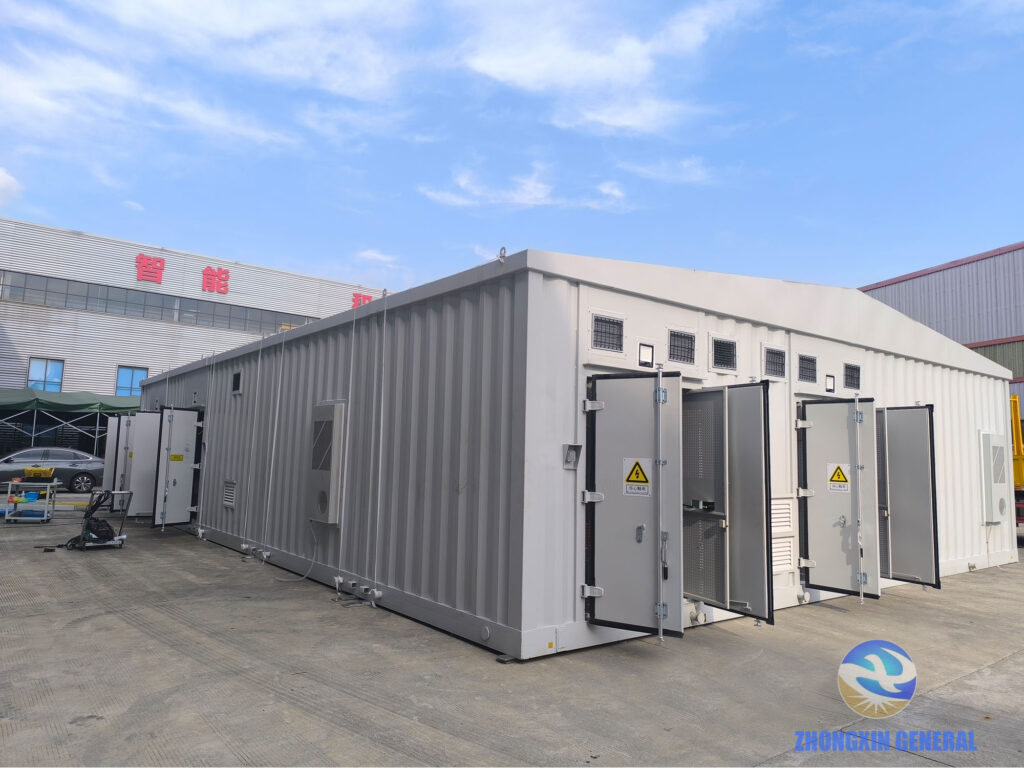
A prefabricated substation of this scale presents a fundamental logistics problem: China’s overland road transport regulations — and those of Kazakhstan and the transit corridors in between — impose strict limits on width, height, weight, and axle load. At 10.5 metres wide and 3.7 metres tall, the assembled unit would have been impossible to move by road without special permits at every jurisdiction, with all the delays, costs, and route restrictions that entails.
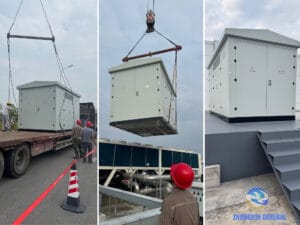
Zhongxin General’s solution was a purpose-designed modular split system: the entire substation structure was engineered to divide cleanly into five independent transport modules — three modules measuring 3.2 m × 10.5 m × 3.7 m and two measuring 2.7 m × 10.5 m × 3.7 m. Critically, every module was fully pre-assembled at the factory: internal equipment, cabling, pipework, and systems were installed and tested inside each module before they were ever separated. This meant on-site installation in Kazakhstan would be reassembly and commissioning — not construction.
Each module was sized to comply with international road transport standards without requiring special oversize permits. As General Manager Zhang Shaokuan explained to Chengdu Daily reporters on dispatch day: the dimensions were calculated against bridge load ratings, tunnel clearance envelopes, and customs documentation requirements along the entire 4,500-kilometre route.
Inside the Substation: Five Functional Zones in One Integrated Structure
Journalists from Chengdu Daily and Xingjin District Media described the substation’s interior as a “miniature power town” — a self-contained electrical infrastructure in five coordinated zones:
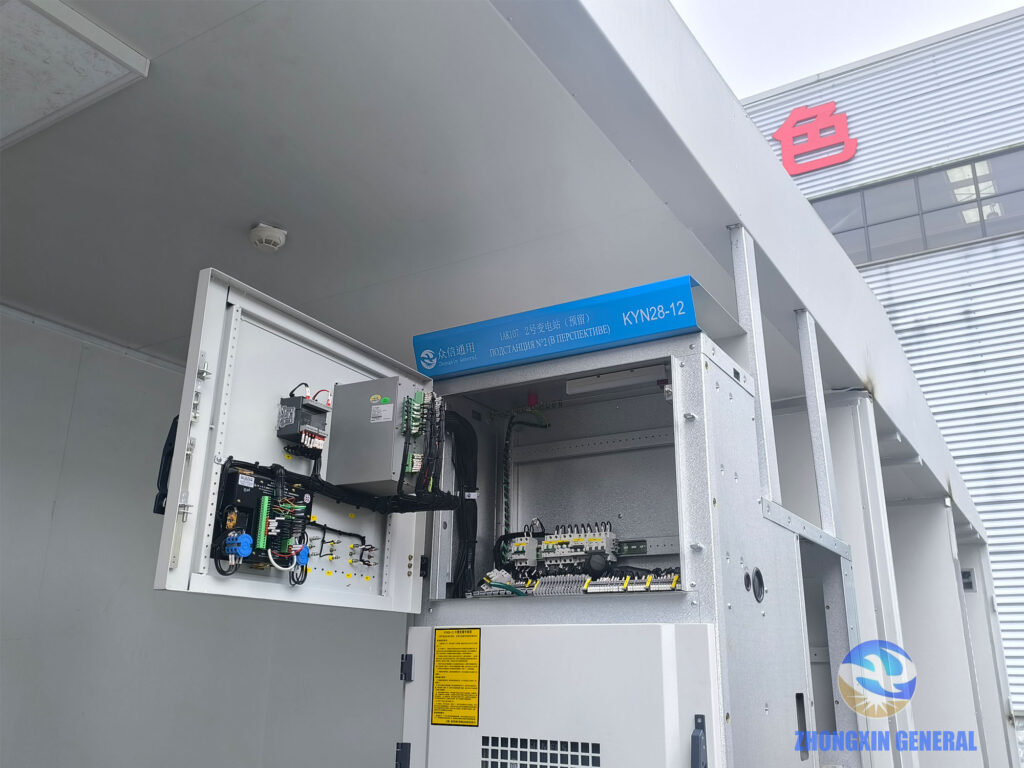
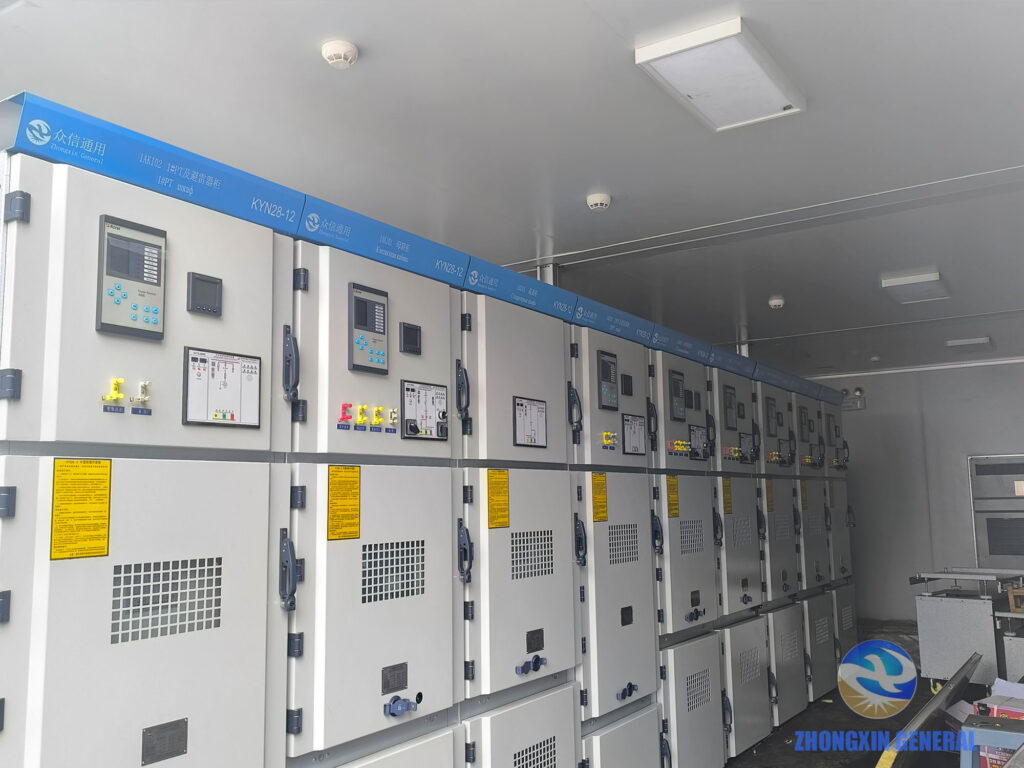
High-Voltage Switchgear Room:
14 units of KYN28-12 air-insulated metal-clad withdrawable switchgear, with vacuum circuit breakers using spring-energy operating mechanisms at DC 110V. All units are equipped with microcomputer relay protection devices with communications interfaces, enabling intelligent protection and SCADA integration.
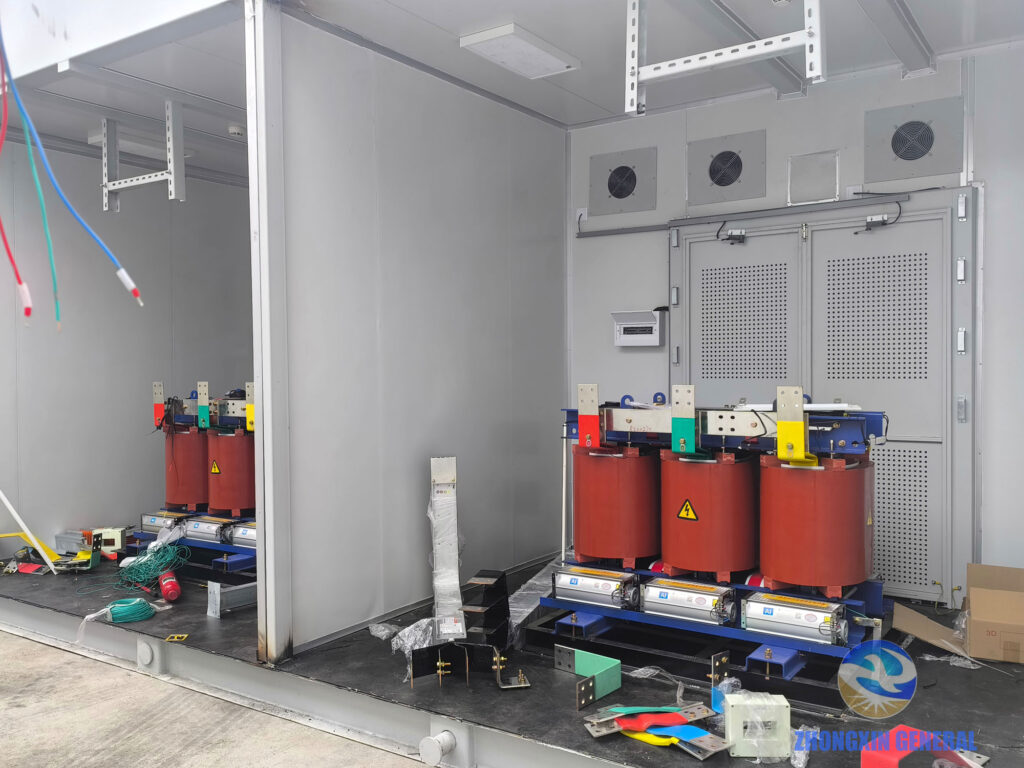
Two Transformer Rooms:
Each housing one 800 kVA ZHONGXIN GENERAL dry-type transformer, manufactured by Zhongxin General in-house. These units deliver lower losses, lower acoustic noise, and higher reliability than conventional designs, with energy efficiency that exceeds comparable Sichuan-market units by more than 5%. Using own-manufactured transformers gives Zhongxin General full control over the specification chain from transformer to substation system.
Low-Voltage Distribution Room:
12 withdrawable low-voltage switchgear units for distribution to port loads — withdrawable design for ease of maintenance.
Control Room:
The substation’s integrated “brain” — housing three AC/DC panels, one integrated rear-end monitoring unit, an RTU control cabinet, fire suppression control panel, environmental control distribution box, and a battery + UPS system for uninterrupted operation. The control room enables fully unattended 24/7 operation with remote monitoring capability.
Environmental Control: Engineered for the Caspian Climate
Aktau’s climate is demanding: a continental–maritime combination that produces cold winters, hot summers, high annual temperature swings, coastal humidity, salt-laden air, and significant dust loading from Kazakhstan’s arid interior. Standard substation environmental systems are not adequate for this combination.
Zhongxin General’s engineers designed a multi-layer environmental control system specifically matched to Aktau’s conditions:
- Precision industrial air conditioning (not commercial HVAC) with N+1 redundancy ensuring 100% cooling capacity at all times; target internal temperature maintained at 25 ± 2°C
- Active dehumidification to prevent condensation — particularly critical for the coastal environment where salt-laden humid air can cause insulation degradation and corrosion
- Air conditioning units selected for Aktau’s extreme peak temperatures, solar radiation intensity, and altitude — all modelled during the design phase
- Transformer rooms use mechanical forced-ventilation systems with axial fans, motorised louvres, and multi-stage dust filtration — inlet grilles mounted 300 mm above floor level with 90-degree rain hoods, mechanical louvres, dust filters, and electric fire dampers
- Overall enclosure protection rating and corrosion resistance upgraded for coastal salt-air service
- Integrated fire detection and suppression system, coordinated with the ventilation control logic
Manufacturing Process: Factory-Complete Pre-Assembly
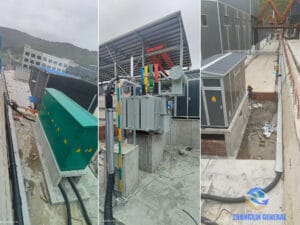
The modular design’s real advantage becomes clear in the manufacturing approach. Rather than shipping loose equipment for field assembly in Kazakhstan, Zhongxin General completed all internal installation — switchgear mounting, transformer installation, cabling, pipework, relay programming, and environmental systems — inside each module at the Xinjin factory, then tested the complete system assembled before separation.
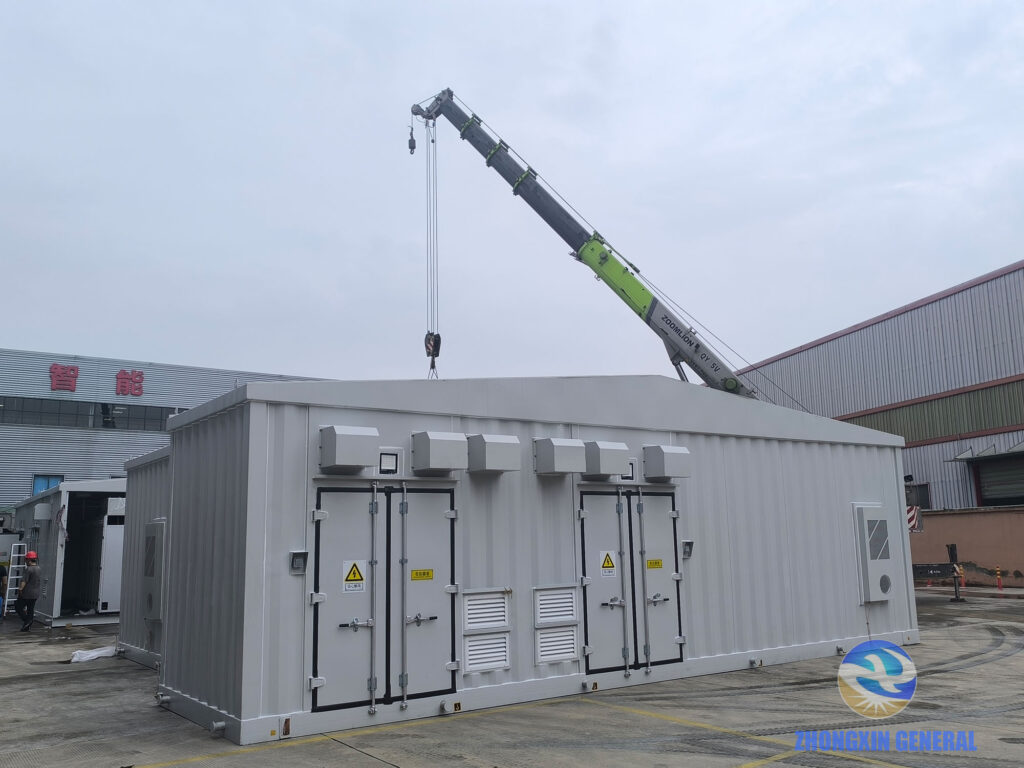
This factory-first philosophy drastically reduces on-site installation time and risk. When the five modules arrive at Aktau, the installation team’s task is structural reassembly and system commissioning — not equipment installation from scratch in a port environment 4,500 kilometres from the factory.
Packing, Loading, and Dispatch
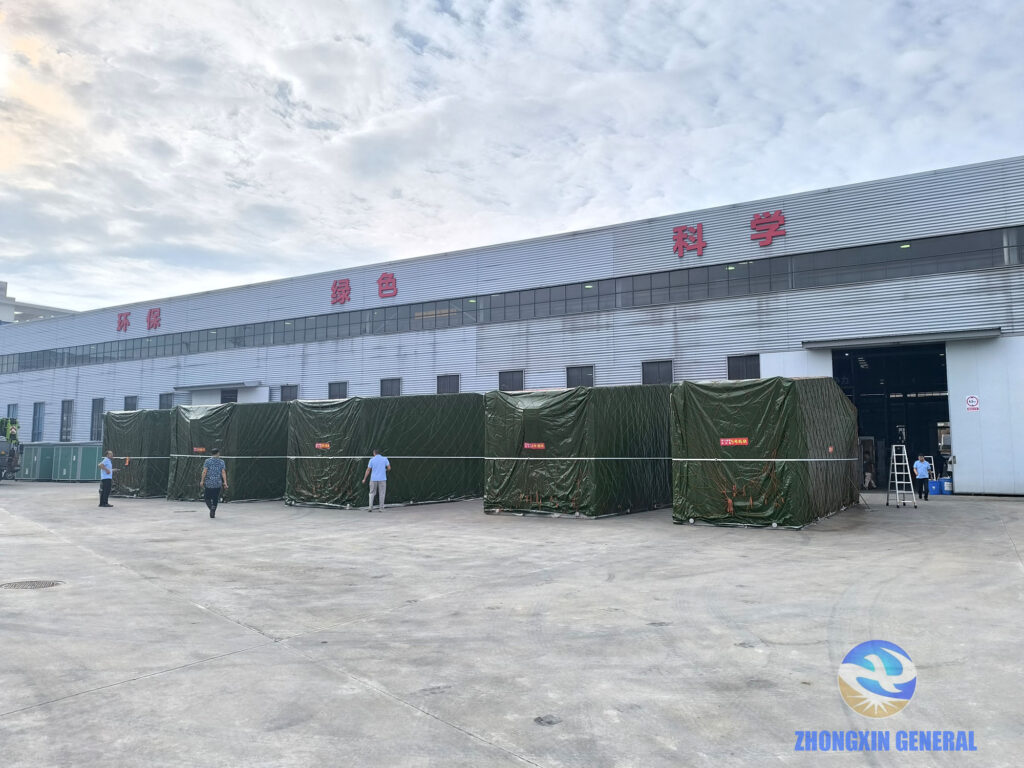
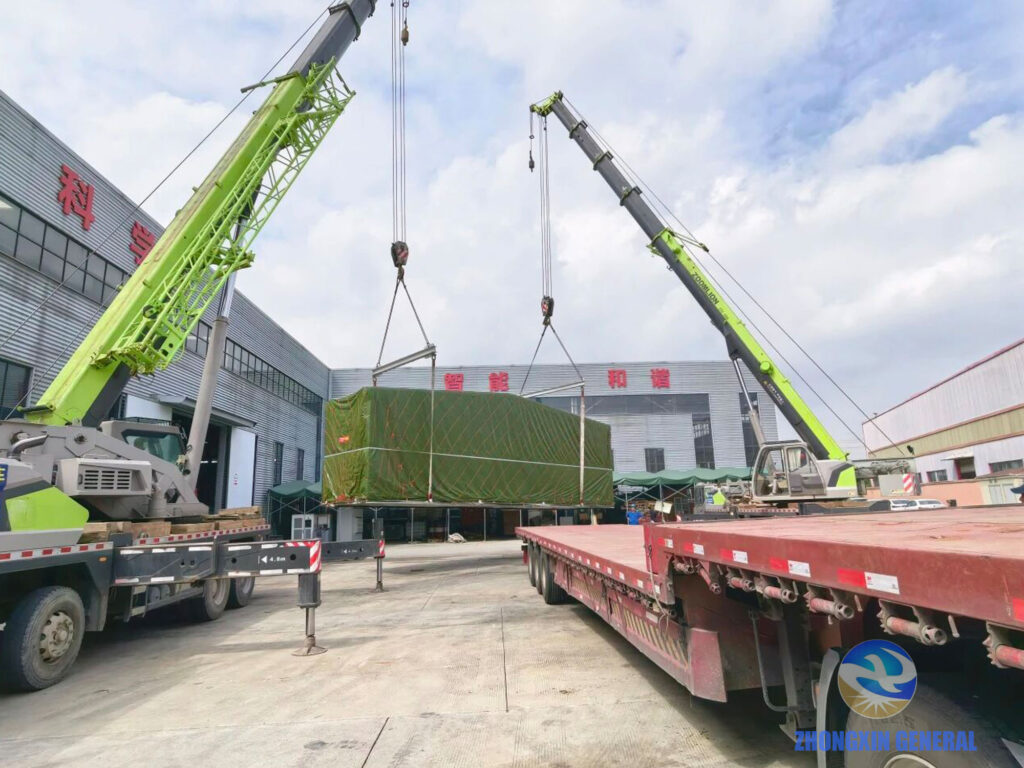
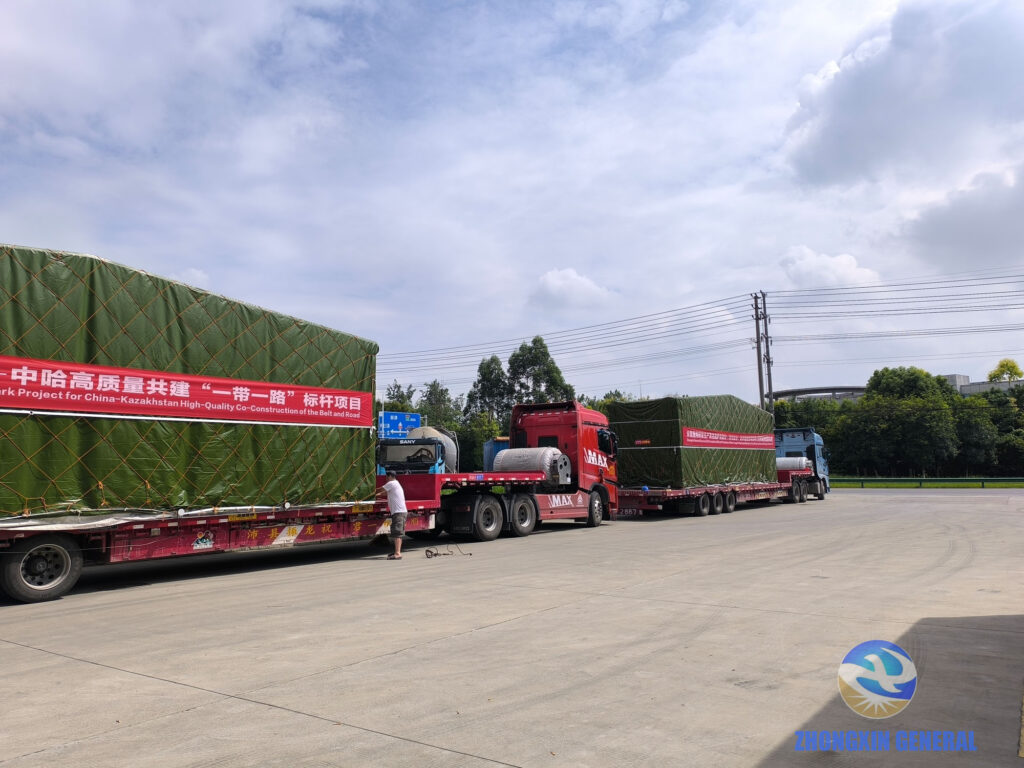
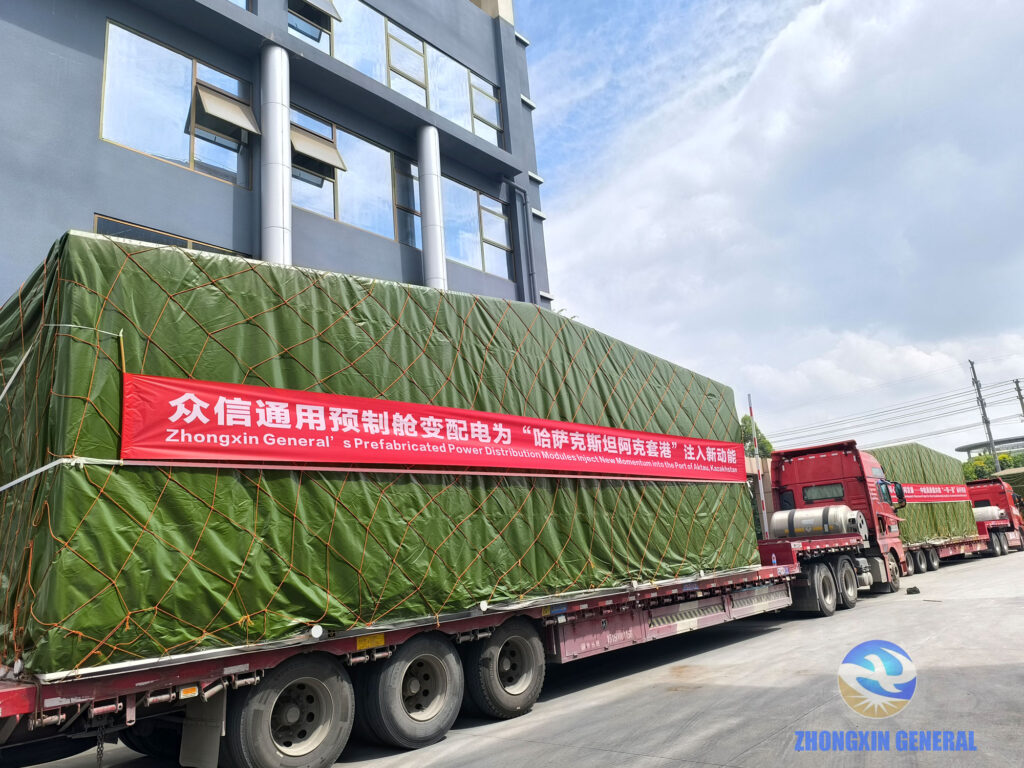
On 1 September 2025, five flatbed trailers — each 17.5 metres long — were loaded with the five substation modules at Zhongxin General’s Xingjin facility. Chengdu Daily reporters and Xingjin District Media were present on-site to document the dispatch. General Manager Zhang Shaokuan was interviewed on camera by Chengdu Daily, explaining the engineering rationale and the project’s significance for China–Kazakhstan infrastructure connectivity.
The Route: Sichuan to the Caspian Sea
The convoy’s route: Xingjin (Chengdu) → Xinjiang → Horgos Border Port → Aktau, Kazakhstan — approximately 4,500 kilometres overland. After completing customs clearance at Horgos, the modules continued by road to Aktau.
Zhongxin General’s technical team accompanied the shipment to Kazakhstan to supervise on-site installation, module reassembly, and commissioning. The complete substation was scheduled for commissioning and energisation by the end of 2025, at which point it would assume its role as the primary power core for the Aktau container hub’s extended project’s operation.
Project Significance: Chinese Power Engineering on the Trans-Caspian Route
The Aktau container hub is a flagship project of China–Kazakhstan cooperation under the Belt & Road Initiative. As a key node on the Trans-Caspian International Transport Route — the sea crossing that connects China–Europe rail freight across the Caspian — Aktau’s capacity and operational reliability directly affect the efficiency of the entire corridor.
As Zhang Shaokuan stated at the dispatch ceremony to Chengdu Daily reporter: “This is not just the export of electrical equipment — it is a vivid demonstration of Chinese technology, Chinese standards, and Chinese solutions entering the international market. We are proud to contribute to Belt & Road construction and to China–Kazakhstan infrastructure connectivity.”
For Zhongxin General, the Aktau project is a demonstration of the full capability stack that separates a genuine systems integrator from a component supplier: in-house transformer manufacturing, switchgear integration, prefabricated enclosure engineering, climate-adaptive environmental systems design, and the logistical engineering to deliver a complete substation — factory-tested and road-legal — across Central Asia.
Technical Summary: Key Specifications
| Zone | Equipment | Specification |
| HV Switchgear Room | KYN28-12 Switchgear | 14 units, air-insulated, metal-clad, withdrawable; vacuum CB; spring mechanism; DC 110V; microprocessor protection with comms |
| Transformer Room (×2) | ZHONGXIN GENERAL Dry-Type | 800 kVA each; own manufacture; low loss, low noise; >5% more efficient than regional comparable units |
| LV Distribution Room | LV Switchgear | 12 units, withdrawable design |
| Control Room | Integrated Control & Monitoring | AC/DC panel ×3, rear-end monitoring unit ×1, RTU ×1, fire control ×1, env. control panel ×1, battery+UPS ×1; unattended 24/7 operation |
| Environmental System | HV/LV/Control: Precision HVAC | N+1 redundancy; 25±2°C; active dehumidification; dust filtration; corrosion protection |
| Environmental System | Transformer Rooms: Forced Ventilation | Axial fans, motorised louvres, multi-stage dust filter, electric fire dampers |
| Structure | Modular Split | 5 modules (3 × 3.2 m wide + 2 × 2.7 m wide; all 10.5 m × 3.7 m); within international road transport limits |
| Overall Assembled | Full Substation | 15 m × 10.5 m × 3.7 m; 5 functional zones; factory pre-assembled and tested |
Related Case Studies
- 31,500 kVA OLTC Transformer — Jing Teng Energy 35kV Dedicated Substation, Xinjiang → Main transformer for a new dedicated industrial substation in Alar City, Xinjiang. Delivered January 2026, confirmed in operation March 2026.
- 8,000 kVA OLTC Transformer Export to DR Congo → International export case study: factory acceptance, nitrogen transport, port rerouting, and verified arrival at Mtwara Port, Tanzania.
- 63 MVA / 110 kV OLTC Transformer — Ningxia LNG & Helium Project → Our largest recent OLTC delivery: 150 tonnes, 110 kV, for a strategic LNG and high-purity helium facility. Six months of uninterrupted operation since July 2025.
- Intelligent Power Distribution System — Xingjin District People’s Hospital → 16,730 kVA intelligent power distribution system for a 129,900 m² hospital campus — another mission-critical, zero-interruption application.
About Zhongxin General Electric Energy Co., Ltd.
Zhongxin General is a Sichuan-based manufacturer of oil-immersed and dry-type power transformers, medium-voltage switchgear, prefabricated substations, microgrids, energy storage systems, and cloud-based power monitoring platforms. The company holds National “Specialized, Refined, Distinctive & Innovative” (Little Giant) Enterprise status — China’s highest SME innovation designation — alongside National High-Tech Enterprise certification and Sichuan Provincial Enterprise Technology Center recognition.
Product range covers 30 kVA to 100 MVA across voltage classes from 6 kV to 132 kV, with both GB and IEC/ANSI standard variants for international projects. Strategic cooperation with State Grid Corporation of China and China Southern Power Grid validates quality management and delivery capability at utility scale.
Delivered to power infrastructure projects in Kazakhstan, the Democratic Republic of Congo, Tanzania, Argentina, Thailand, Nepal, Burma, Indonesia, Europe, and across China.
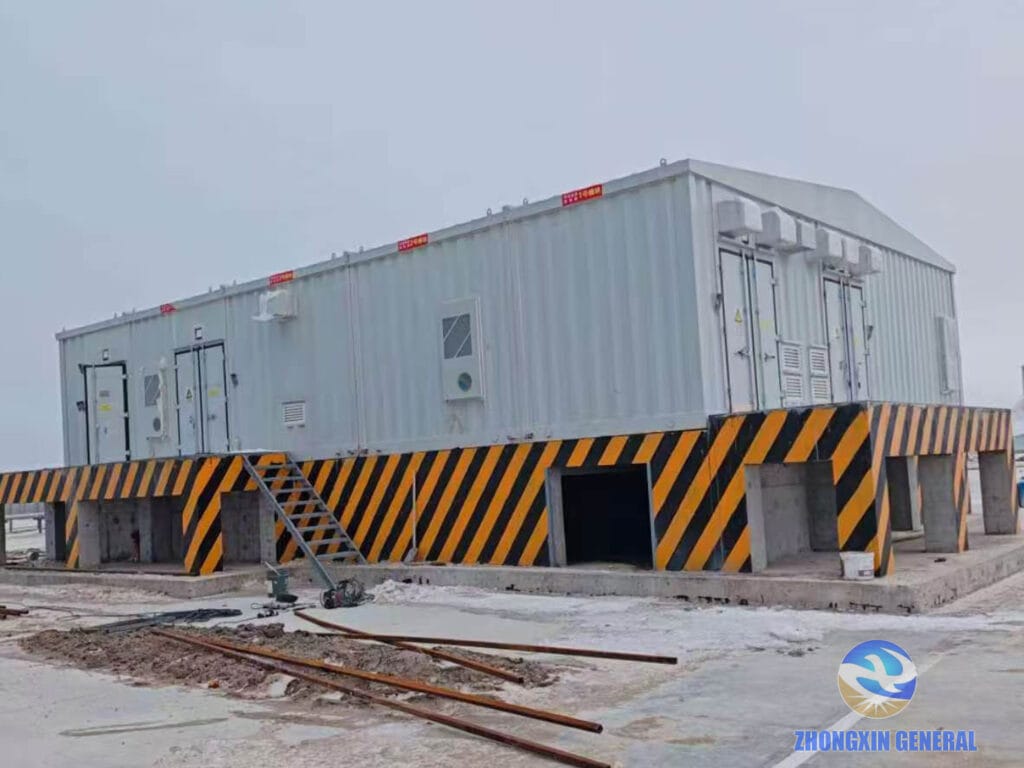
Update — 20th July, 2026: The substation’s on-site installation and commissioning at Aktau Port was completed on 18th January 2026. The photo below, taken on-site, shows the fully installed and commissioned unit now serving as the container hub’s primary power core.
Enquire About Your Project
Whether you need a prefabricated substation for a port, industrial facility, renewable energy project, or remote infrastructure site — and whether your environment demands tropical, desert, coastal, or extreme cold specifications — Zhongxin General’s engineering team can design a solution for your specific requirements.
→ Contact Our Engineering Team → View Prefabricated Substation Product Range → Browse All Case Studies