Introduction: One Decision That Changed an Industry
On February 21, 1988 — the fifth day of the Chinese Lunar New Year — a 26-year-old technician named Zhang Xin walked through the muddy streets of Changji, Xinjiang, holding a transfer letter to become an electrical engineer at the Urumqi Chemical Plant. The offer came with a 30% salary increase and a new two-bedroom apartment. For a young technician earning just 75.63 yuan per month and sharing a cramped 20-square-meter rental, this was the opportunity of a lifetime.
But before leaving, Zhang Xin went to say goodbye to his mentor, Wang Xiuzhi — a winding technician at the Changji Transformer Factory where he had worked for three years. That visit changed everything.
Today, TBEA Co., Ltd. (600089.SS) is the world’s leading ultra-high voltage transformer manufacturer, with a global market share of approximately 12% in the transformer segment and over 45% in China’s domestic UHV transformer market. It is the only company globally to have achieved mass production of ±1100kV converter transformers, a technology that remains unmatched by any other manufacturer.
This is the story of how a debt-ridden street repair small factory became the world‘s most advanced transformer manufacturer — told through public records, corporate filings, and the founder’s own words.
1988: The Winter That Could Have Ended Everything
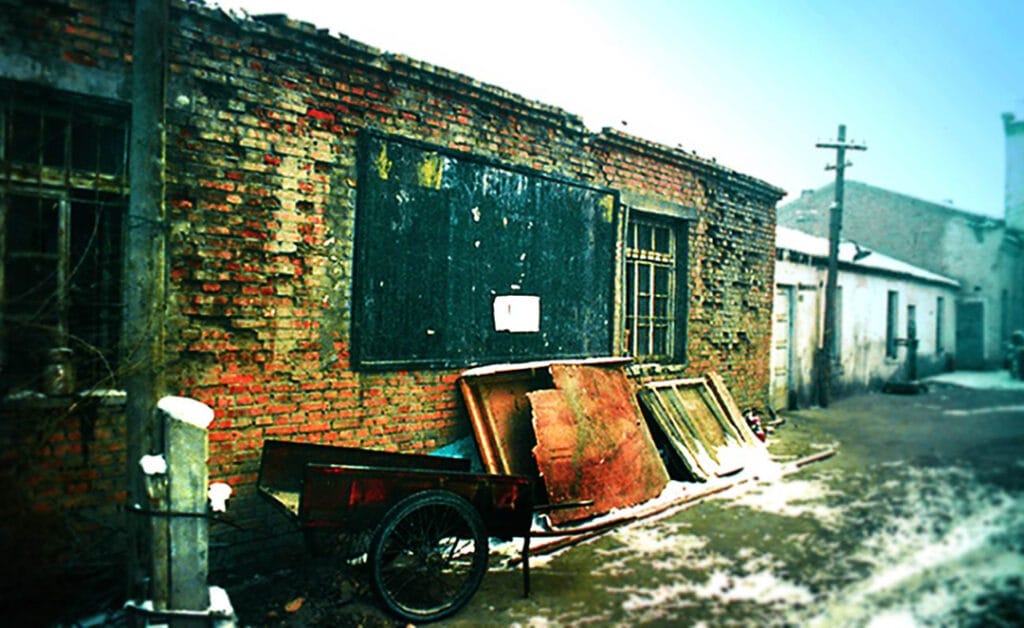
In early 1988, the Changji Transformer Factory was a dying enterprise. Total assets: just 158,000 yuan. Total debt: 730,000 yuan. The bank account held 200 yuan. Annual sales revenue was less than 100,000 yuan. Most employees had already left; by the time Zhang Xin took over the management of the factory from technician, the workforce had shrunk from over 300 to just 53 people including himself.
The final blow came when a heavy snowfall collapsed the dilapidated factory roof, burying equipment under snow and debris.
Most employees survived by selling what they could. Thirty-two families couldn’t afford to keep their children in school. Wages had not been paid for six months.
“You People With Ability — All of You Are Leaving“
When Zhang Xin went to say goodbye to Wang Xiuzhi, he walked through muddy streets into a low house where the afternoon sunlight gave way to near-total darkness. A worn table. A few broken chairs. A plastic sheet hanging from the ceiling. Several basins on the floor catching water dripping through the roof.
He told her he was leaving for the Urumqi Chemical Plant. He expected her to wish him well. Instead, she began to cry.
”You people with ability — all of you are leaving,“ she said. ”How are the rest of us supposed to eat? Just look at my home.“
She insisted he stay for dinner — a bowl of noodles with pickled vegetables, the best food her family had for the New Year. Sitting in the drafty room, Zhang Xin felt his heart sink.
”Zhang,“ Wang Xiuzhi said, looking at him with pleading eyes, ”if you stay and lead us, maybe we can still have a chance.“
That night, Zhang Xin couldn’t sleep. The next morning, he went to see the Party secretary, Liu Detian — a veteran of the Korean War who was Zhang’s Party introducer in 1986. What Zhang Xin saw next after he decided to make a family visits convinced him finally: house after house, families huddled around small fires, doors that wouldn’t close properly, almost no food for the New Year.
Two sleepless nights later, with the encouragement of Party secretary Liu Detian, Zhang Xin went to the city government. “I want to stay,” he told the officials. “I want to stay and fight — together with everyone else.”
On March 3, 1988, the Changji Transformer Factory held what is believed to be Xinjiang‘s first democratic election for factory director. Of the 53 employees including himself and Party secretary Liu Detian, 51 voted for Zhang Xin. He was just 26 years old.
Zhang Xin led the factory’s 52 employees in salvaging whatever they could — bricks from collapsed walls, scrap metal from junkyards, tools from their own homes. By July 1988 — just four months after he took over — employees finally received their salary. For the full year, the factory achieved output value of 1.22 million yuan and profit of 178,000 yuan, a dramatic turnaround from near-bankruptcy.

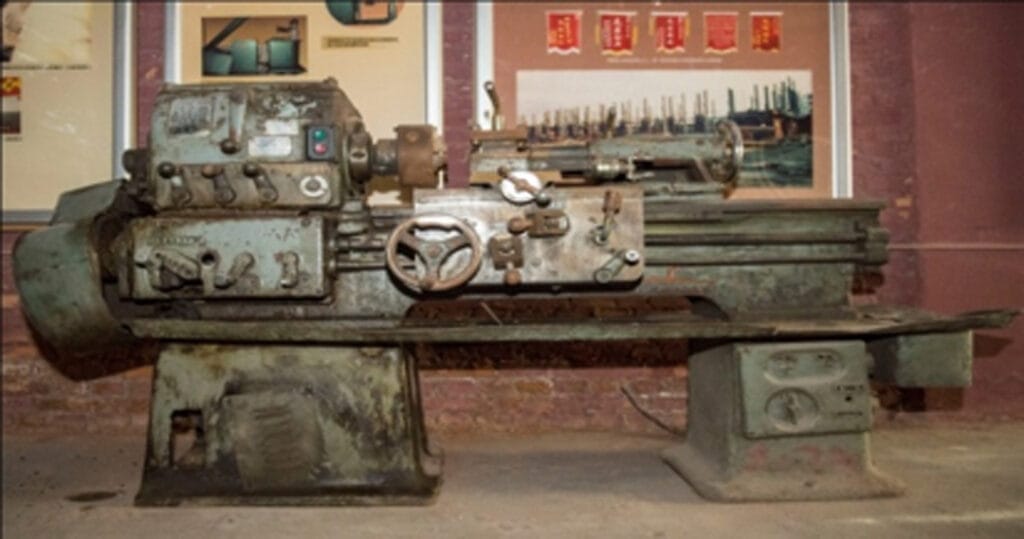
When Zhang Xin took over, the factory had only three manual winding machines and one manual plate shearing machine. Transformers were assembled using hand tools. Below was one of the equipments that 53 people used to turn the factory around.
The 1992 Choice: 1.97 Million Yuan vs. The Future
By the end of his first five-year contract in 1992, the transformation was remarkable. The factory had fixed assets of 17 million yuan, annual sales revenue of 10.8 million yuan, and profit of over 2 million yuan. Under the terms of his contract, Zhang Xin was personally entitled to offer 1.97 million yuan as performance bonuses for the whole factory team — enough to make him and every one of his employees a rich person in the year of 1992.
Instead, Zhang Xin and his team chose to reinvest every penny into the company. That decision funded the construction of the company’s first modern factory and marked the beginning of a new phase. This early commitment to reinvesting profits — what Charlie Munger called the principle of compounding — would prove critical to TBEA’s later success.
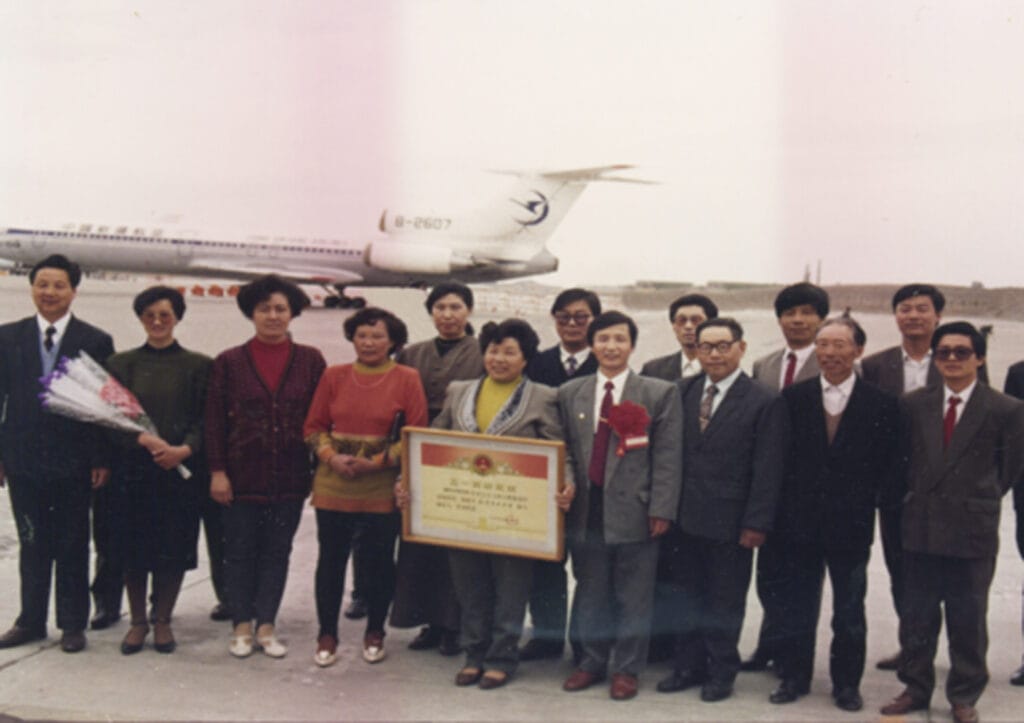
That same year, TBEA was awarded the National May Day Labor Award — a testament to the collective spirit of its whole employees.
Becoming China’s First Listed Transformer Manufacturer
In 1993, TBEA became one of the first companies in China’s transformer industry to undergo shareholding restructuring. Four years later, on June 18, 1997, TBEA completed its initial public offering on the Shanghai Stock Exchange, raising 148 million yuan. It became China’s first listed transformer manufacturer, stock code 600089.
The listing marked TBEA’s transformation from a regional small enterprise to a national-scale company. With access to public capital, Zhang Xin could now pursue an aggressive acquisition strategy that would fundamentally reshape China’s transformer industry.
The M&A Campaign That Built a National Champion
Zhang Xin saw an opportunity that others missed: many of China’s most historic transformer factories — with deep technical expertise but ossified state-owned management structures — were struggling to survive in the newly competitive market.
Between 1998 and 2003, TBEA systematically acquired the crown jewels of China’s power transmission industry:
- 1998: Sichuan Deyang Cable Factory
- 2000: Hengyang Transformer Factory — then ranked fourth in the industry nationwide
- 2003: Tianjin Transformer Factory — which had produced China’s first dry-type transformer and has over 50 years of transformer manufacturing history and 30 years of dry-type transformer R&D experience
2003: Acquiring Shenyang Transformer Factory— the “Father of PR China’s Transformer Industry”
Zhang Xin’s most ambitious target was Shenyang Transformer Factory — the “father of PR China’s transformer industry.” Founded in 1938, Shenyang Transformer was the oldest and largest transformer manufacturer in Asia. It was the national standard-setter, the technological research hub, and the producer of China’s highest-voltage, largest-capacity transformers.
By the early 2000s, Shenyang Transformer was struggling under the weight of state-owned bureaucracy. The central government was actively seeking a strategic partner to revitalize it. Competition was fierce — international giants like Germany’s Siemens and domestic rivals were all bidding.
TBEA went through three rounds of competitive bidding before emerging as the winner. The deal closed at the end of 2003.
What happened next surprised many skeptics. TBEA immediately invested nearly 500 million yuan in technological upgrades at Shenyang Transformer — completing the work in just six months. Later, total investment would exceed 3 billion yuan to build a UHV production base. By 2016, the asset base of Shenyang Transformer had grown ninefold from its pre-acquisition level.
Crucially, Shenyang Transformer brought with it a team of world-class engineers who had grown up with China’s transformer industry. Among them was Zhu Yinghao, an academician who would later lead the team that developed TBEA’s world-first 1000kV UHV transformer.
Breaking Into Ultra-High Voltage: A Technological Leap
With Shenyang Transformer’s technical foundation now integrated into TBEA’s platform, the company was uniquely positioned to pursue the next frontier: ultra-high voltage (UHV) transmission. Coinciding perfectly with this capability was the Chinese government’s newly launched national UHV grid expansion plan — a historic alignment of private-sector capability and state-led demand.
In 2006, TBEA began intensive R&D on UHV technology. The investment was massive — billions of yuan channeled into two dedicated research centers. Thousands of experiments were conducted. Coils were punctured, windings destroyed, prototypes failed.
2008: The World’s First 1000kV UHV Transformer
In 2008 — five years after acquiring Shenyang Transformer — TBEA successfully manufactured the world’s first 1000kV UHV transformer, a breakthrough that put the company at the forefront of global power transmission technology.
This was not merely an incremental improvement. UHV technology allows massive amounts of electricity to be transmitted over vast distances with minimal loss — a critical capability for countries with energy resources concentrated far from population centers.
TBEA did not stop there. The company went on to master 1000kV AC, ±800kV DC, and ultimately ±1100kV DC technologies. Today, TBEA has developed a total of 154 world-class new products and created 65 world firsts.
±1100kV: A Voltage Level No One Else Has Mastered
TBEA is the only company globally to have achieved mass production of ±1100kV converter transformers. This is the highest voltage level of any power transmission equipment in commercial operation anywhere in the world.
The Changji-Guquan ±1100kV UHV DC transmission project, which runs approximately 3,300 kilometers from Xinjiang to Anhui Province, is fully equipped with TBEA’s ±1100kV converter transformers. TBEA supplied all 14 units for the Changji end of the project — the world’s first ±1100kV transmission line. No other transformer manufacturer has matched this technical achievement before.
TBEA Today: By the Numbers (2025)
Production Capacity & Market Position
At the end of 2025, TBEA’s transformer production capacity is close to 500 million kVA annually, ranking among the largest in the world. The company holds approximately 12% of the global transformer market and over 45% of China‘s domestic UHV transformer market, with more than 30% share in the ±800kV and above converter transformer segment.
The company operates four major transformer manufacturing bases:
- TBEA Shenyang Transformer Group Co., Ltd. (formerly Shenyang Transformer — founded 1938)
- TBEA Hengyang Transformer Co., Ltd. (acquired 2000)
- Xinjiang Transformer Plant of TBEA Co., Ltd. (the original Changji facility)
- Tianjin TBEA Transformer Co., Ltd. (China’s first dry-type transformer manufacturer)
Financial Performance
In the first three quarters of 2025, TBEA reported consolidated revenue of 72.99 billion yuan, with net profit attributable to shareholders of 5.48 billion yuan, representing year-on-year growth of 27.6%. The power transmission and transformation segment alone generated 34.2 billion yuan in revenue during the same period, maintaining a gross margin of 18.5% on high-end equipment despite rising raw material costs.
The company invested 4.8 billion yuan in R&D during fiscal 2025 (4.5% of operating income) and maintains a portfolio of over 3,200 active patents focused on 1000kV UHV and flexible DC transmission technologies, supported by a dedicated R&D workforce of more than 5,000 specialized engineers.
International Expansion
TBEA’s international presence has grown substantially. In 2025, the company secured a record 16.4 billion yuan contract from Saudi Electricity Company — the largest single order in China’s power transmission and transformation equipment export history. The company’s international product contracting exceeded $1.2 billion in the first three quarters of 2025, up over 80% year-over-year. TBEA now operates in over 90 countries, with international operations accounting for 18% of revenue growth.
Why TBEA Matters to Global Transformer Buyers
For procurement professionals, project developers, and engineering firms sourcing transformers from China, TBEA represents a proven, large-scale manufacturing partner with capabilities that few other suppliers can match:
- Unmatched UHV capability: TBEA is the only manufacturer worldwide with mass production experience of ±1100kV converter transformers — a capability that matters for large-scale long-distance transmission projects.
- Deep technical heritage: Through its acquisition of Shenyang Transformer (founded 1938), TBEA inherited over eight decades of continuous transformer R&D and manufacturing expertise, including the engineers who literally wrote China’s transformer standards.
- Vertically integrated production: TBEA’s four major transformer manufacturing bases provide geographic diversity and supply chain resilience.
- Global delivery track record: With exports to over 90 countries and a landmark 16.4 billion yuan contract in Saudi Arabia, TBEA has demonstrated its ability to execute large-scale international projects.
- Cost-performance advantage: In recent project comparisons, TBEA’s smart transformers have delivered approximately 70% of the functionality of premium Western brands at roughly half the cost.

References & Further Reading
The information presented in this article is based on publicly available sources, including TBEA’s corporate annual reports, Shanghai Stock Exchange filings, China People’s Daily, Xinjiang Changji Daily, China Central Broadcasting, and third-party financial analysis reports as cited throughout.
Kevin’s Words: The name TBEA is the abrreviation of tebian Electric Apparatus, firstly came into formation in 1993 when TBEA firstly formed to be a modern shareholding structured company, but it’s real turning point was in 1988 when Mr. Zhang Xin and Secretory Liu took over the management of the former Changji Transformer Factory, and the factory’s real starting point was in 1974 when the Changji Transformer Factory was started. Sometimes many articles suggest that TEBA has a much earlier history than that, as they considered Henyang and Shenyang Transformer Factories, which are a part of TEBA now. But the real core of TBEA is the old Changji Transformer Factory’s management transfer in 1988. This is also the TEBA official understanding of the founding time of TEBA, which was in 1988, not 1993.
When TBEA Is More Than You Need: Matching the Right Manufacturer to Your Project Scale
TBEA’s capabilities are genuinely world-class — and so is the scale of projects they’re built for, the Changji–Guquan ±1100kV transmission line, utility-scale grid infrastructure and orders measured in hundreds of millions of dollars.
For buyers sourcing outside that segment — like industrial zone substations, port power systems, hospital infrastructure, Belt & Road facility projects, or medium-voltage distribution from 30 kVA to 100 MVA under 138kV — the procurement consideration looks quite different. What matters at that scale is technical competence, responsive engineering, export experience, and a supplier who treats no matter a 630 kVA or 16,000 kVA order with the same seriousness as a 1000 MVA 1000 kV one.
That’s the segment where Zhongxin General operates.
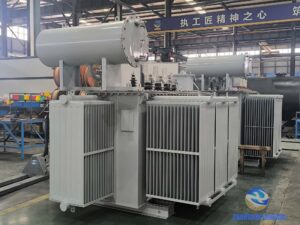
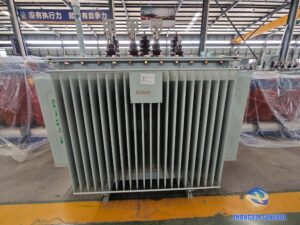
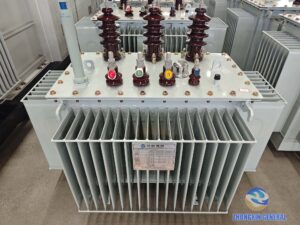
Sichuan Zhongxin General Electric Energy Co., Ltd. is a National “Little Giant” Enterprise and National High-Tech Enterprise based in Chengdu, manufacturing oil-immersed and dry-type power transformers, medium-voltage switchgear, and prefabricated substations across voltage classes from 0.4kV to 138kV, and rated capacity ranged from 30 kVA to 100 MVA. The company has delivered complete power infrastructure to industrial zones, port substations (including Kazakhstan’s Aktau container hub on the Trans-Caspian route), hospital campuses, LNG facilities, and power station projects across Africa and Central Asia — in both GB and IEC/ANSI configurations.
If your project doesn’t require ±1100kV, but does require a manufacturer who knows what they’re doing: → View Zhongxin General’s Project Cases → Contact Zhongxin General’s Sales Team
About This Series
This article is the first installment in our ongoing series profiling leading transformer manufacturers in China. As part of this initiative, we will also introduce major power transformer factories from around the world.
Our genuine goal is to learn from and pay tribute to the world‘s most advanced transformer companies — both domestic and international. All data and information presented in this series are sourced exclusively from publicly available, legitimate channels. This content is intended for research, discussion, and the healthy exchange of industry knowledge — with the hope of contributing to the positive development of the global power transformer sector.
If this series helps you discover reliable manufacturing partners or gain deeper insights into the industry, that would be our greatest reward.