Live Transformer Replacement Using Mobile Box Type Substations: How China’s Utilities Achieve Zero Downtime

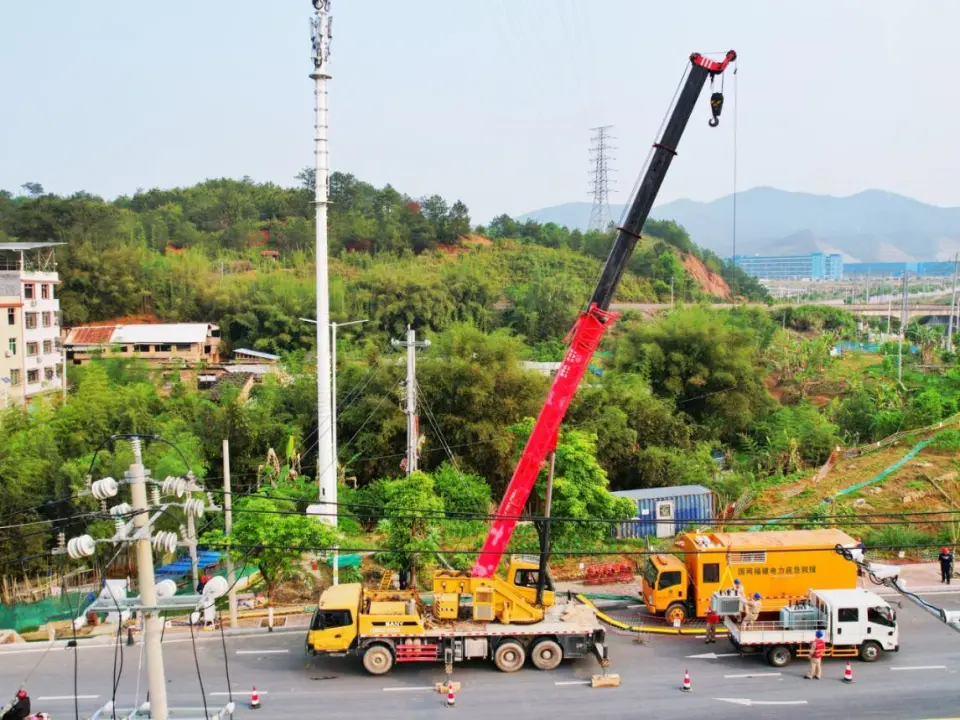
Four-vehicle site overview of completed live transformer replacement — mobile substation, crane, transformer transport, and bucket truck, Yongding Fujian 2024
China's grid operators have quietly mastered a technique that eliminates the traditional 4–6 hour blackout when replacing a distribution transformer. Using a mobile box-type substation as a temporary bypass supply, crews can swap out an old unit while connected customers experience zero interruption. This article explains the method, the specialist vehicles involved, and documents five real-world cases carried out across China between 2020 and 2026.

Replacing a distribution transformer has traditionally meant one thing: a planned outage. Customers — whether a residential block, a factory floor, or a hospital — simply wait while crews disconnect the old unit, install the new one, and restore supply. The typical window runs four to six hours, sometimes longer.

Chinese grid operators have developed a method that eliminates this outage entirely. By deploying a mobile box-type substation as a temporary parallel supply, the old transformer can be isolated and removed while connected loads never lose power. The new transformer is then installed and energized, and the mobile unit is quietly withdrawn. From the customer’s perspective, nothing happened.

This article documents how the method works, the specialist equipment it requires, and five real-world cases carried out across China between 2020 and 2026 — each one marking a regional “first” for the technique.

Why the Demand for Zero-Downtime Replacement Is Growing

Every transformer has a service life and a capacity ceiling. As electricity consumption climbs — driven by industrial expansion, EV charging infrastructure, and the electrification of heating — distribution transformers that were correctly sized a decade ago increasingly find themselves running at or above rated load.

When a transformer reaches the end of its service life or requires an upgrade in capacity, the conventional response has always involved a planned interruption. For residential areas, this is an inconvenience. For manufacturing facilities, it means halted production lines, scrapped batches, and contractual penalties. For hospitals, commercial data centers, and continuous-process industries, it is simply not acceptable.

The “zero-downtime” or “live replacement” approach directly addresses this constraint. It does not require any change to the underlying transformer technology being installed — standard oil-immersed or dry-type distribution transformers are used throughout. What changes is the sequencing of the operation, and the addition of one key piece of equipment.

The Core Method: Mobile Box-Type Substation as Temporary Bypass

Three specialist vehicles deployed for live transformer replacement — mobile substation, crane, and insulated bucket truck, Baoji Shaanxi 2026
Overview of the full vehicle deployment for a zero-downtime transformer replacement operation in Qianyang County, Baoji, Shaanxi Province. Left to right: the mobile box-type substation vehicle, the transformer crane, and the insulated aerial work platform truck. April 2026.

The fundamental logic of the method is straightforward. Before the existing transformer is touched, an alternative supply path is established. A mobile box-type substation — a complete, self-contained transformer and switchgear assembly mounted on a road vehicle — is connected to the same distribution network, upstream of the transformer being replaced. Once the mobile unit is supplying the downstream load, the original transformer can be isolated, removed, and replaced without interrupting supply to any connected customer.

In practice, the operation proceeds through five distinct phases:

Phase 1 — Site Preparation and Mobile Substation Positioning

The mobile box-type substation vehicle is positioned at the work site. Depending on the local network configuration, the mobile unit may take its high-voltage supply from the same overhead line serving the existing transformer, or from an adjacent network point. Ground crews lay flexible HV and LV cables connecting the mobile unit to the network.

Ground crew laying flexible HV cables from overhead tap-off to mobile box-type substation — Xinchang County Zhejiang live replacement 2020
Ground crew carefully routing flexible cables from the overhead connection point to the mobile box-type substation vehicle. Xinchang County, Zhejiang Province, December 2020. Routing cables through uneven terrain and around site obstructions is a key ground-level task in every live replacement operation.
Crew deploying flexible cables to mobile box-type substation vehicle — industrial zone live transformer replacement, Wuxi Jiangsu 2023
Ground crew deploying flexible cables connecting the mobile box-type substation to the 20 kV distribution network. The work site in the Wuxi Economic Development Zone included additional routing challenges: HV cable had to be routed through low vegetation that required clearing and protection with waterproof sheeting. Wuxi, Jiangsu, March 2023.

Phase 2 — Live Connection to the Overhead Network

This is the most technically demanding phase. Insulated aerial work platform vehicles (commonly called insulated bucket trucks or insulated boom trucks) lift crew members to the level of the overhead conductors. Working under full live-line conditions and wearing arc-rated PPE, the operators make the high-voltage connections that bring the mobile substation into the network.

Insulated aerial work platform truck and crew arriving at work site for live transformer replacement operation — Shuangliu District Chengdu 2023
The insulated aerial work platform truck and work crew arrive at the operation site in Shuangliu District, Chengdu. The bucket truck’s primary role in this operation is to lift operators to overhead line height to make the live HV connections supplying the mobile box-type substation. June 2023
Insulated bucket truck operator making live high-voltage connection at overhead distribution line — mobile substation bypass, Shuangliu Chengdu 2023
Close-up view of the live-line connection work at the overhead conductors. The operator, working from an insulated aerial platform, connects the flexible HV cable from the mobile box-type substation to the energized distribution line. Shuangliu District, Chengdu, June 2023.
Operator in insulated bucket truck making live HV connection at overhead line — mobile substation bypass, Baoji Shaanxi April 2026
An operator is lifted to overhead line height in an insulated aerial platform to make the live HV connection for the mobile substation bypass supply. Qianyang County, Baoji, Shaanxi Province, April 2026.
Operator in insulated bucket truck taking HV supply for mobile substation at overhead line — Xinchang County Zhejiang 2020
Aerial platform crew making the live overhead connection to supply the mobile box-type substation. Sanjiing Village, Xiaojiang Town, Xinchang County, Zhejiang Province, December 2020. This was the first deployment of the mobile substation replacement technique in Xinchang County.

Phase 3 — Load Transfer and Original Transformer Isolation

With the mobile substation now energized and supplying the load in parallel with the original transformer, the original unit is de-energized and isolated from the network. The switchgear operations required to achieve this — opening the LV distribution panel, operating the dropout fuse cutouts on the HV side — are carried out in a controlled sequence.

Operator closing LV panel switch on mobile box-type substation to transfer load — zero-downtime transformer replacement, Shuangliu Chengdu
With the mobile substation now energized from the overhead network, the operator closes the LV distribution panel to transfer the connected load to the bypass supply. At this point the original transformer can be safely isolated. Shuangliu District, Chengdu, June 2023.
Insulated bucket truck operator isolating original transformer under live-line conditions — 20kV mobile substation operation, Wuxi Jiangsu 2023
An operator working from an insulated aerial platform isolates the original transformer from the energized 20 kV network. This step — performed while the mobile substation carries the full load — marks the transition from Phase 2 to Phase 3 of the live replacement sequence. Wuxi Economic Development Zone, Jiangsu, March 2023.
Crew member inspecting cable connection interfaces on mobile box-type substation vehicle — Yongding District Fujian live replacement 2024
A crew member checks the cable connection interfaces on the mobile box-type substation vehicle before energization. Thorough inspection of all connection points is a mandatory step before the mobile unit is brought into parallel operation with the live network. Yongding District, Fujian Province, April 2024.

At this point, the original transformer is carrying zero load and has been fully isolated. The connected customers are being supplied entirely by the mobile substation. From their side, supply has been uninterrupted throughout.

Phase 4 — Transformer Removal and New Unit Installation

With the original transformer safely de-energized and isolated, the crane vehicle moves into position. The old transformer — typically an oil-immersed pole-mounted unit weighing several hundred kilograms — is unbolted from its mounting, lifted clear, and removed.

Crane removing old pole-mounted distribution transformer after isolation — live transformer replacement operation, Shuangliu Chengdu 2023
With the original transformer safely isolated and de-energized, the crane vehicle moves into position to remove the old unit from its pole mounting. The mobile substation continues to supply the downstream load throughout this phase. Shuangliu District, Chengdu, June 2023.
Crane lifting new oil-immersed distribution transformer from transport flatbed — live replacement operation, Yongding District Fujian 2024
The new 400 kVA oil-immersed transformer is lifted from its transport flatbed for installation. The mobile box-type substation continues to supply all 100+ connected households throughout the lift and installation sequence. Yongding District, Fujian Province, April 2024.
New oil-immersed transformer being positioned onto double-pole mounting structure — zero-downtime replacement, Yongding Fujian April 2024
The new 400 kVA oil-immersed transformer is guided into position on the double-pole mounting structure. The use of a double-pole configuration — which supports heavier transformers than a single pole — required precise crane positioning to achieve clearance from the adjacent live conductors. Yongding District, Fujian Province, April 2024.

The new transformer — in most of these cases, a unit of substantially higher rated capacity than the one being replaced — is lifted into position, mechanically secured, and connected. HV and LV terminations are made to the network.

New transformer being installed on pole mounting — zero-downtime replacement operation, Shuangliu District Chengdu
The new, higher-capacity transformer is lifted into position on the pole mounting. The mobile box-type substation continues to supply the downstream load while installation and termination work is completed on the new unit. Shuangliu District, Chengdu, June 2023.

Phase 5 — New Transformer Energization and Mobile Substation Withdrawal

Once the new transformer has been installed, connected, and inspected, it is energized and brought into parallel operation alongside the mobile substation. Load is transferred back to the new permanent transformer, and the mobile substation is then isolated and withdrawn from the network. Live-line crews in the aerial platforms remove the temporary HV connections. Ground crews recover the flexible cables.

Crew checking energization status of newly installed transformer — final phase of zero-downtime replacement, Yongding Fujian 2024
With the new transformer installed and connected, crew members verify energization and check operational status before the mobile substation is withdrawn from the network. This inspection confirms that the new unit is carrying load correctly before the temporary bypass supply is removed. Yongding District, Fujian Province, April 2024.

The operation is complete. The connected customers have been supplied without interruption throughout.

Five Real Cases: A Cross-Section of Chinese Practice

The following cases represent documented implementations of this technique across different provinces and network operators, spanning 2020 to 2026. Each was reported as a regional first at the time of implementation, reflecting how recently this capability has been spreading through China’s distribution grid operations.

Case 1 — Xinchang County, Zhejiang Province (December 2020)
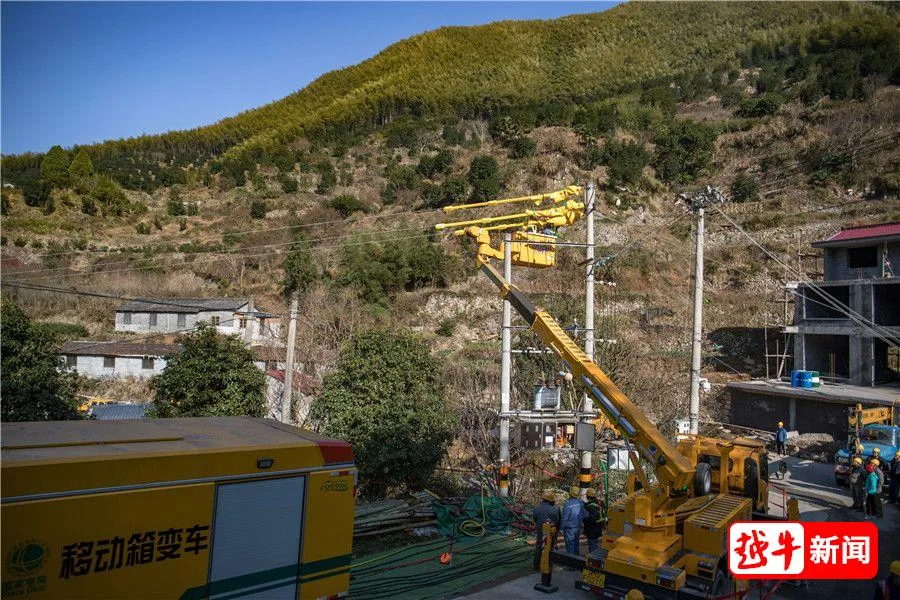
Operator: State Grid Xinchang County Supply Company Location: Sanjiing Village, Xiaojiang Town, Xinchang County Original transformer: 100 kVA Replacement transformer: 400 kVA Customers served: 80+ residential households Operation duration: Approximately 2 hours

This case represents one of the earliest documented deployments of the mobile box-type substation technique for transformer replacement in Zhejiang Province. The existing 100 kVA unit had been running in an overloaded condition for an extended period, with intermittent faults affecting local residents. The work site presented additional complexity due to communications cables routed near the transformer mounting, which required careful planning to avoid contact during the crane operations.

Full site overview of live transformer replacement operation showing mobile substation vehicle, crane, and insulated bucket truck — Xinchang County Zhejiang 2020
Site overview of the Xinchang County live transformer replacement operation, showing the standard three-vehicle deployment: mobile box-type substation vehicle, transformer crane, and insulated aerial work platform truck. Sanjiing Village, Xinchang County, Zhejiang, December 2020.

The operation was completed in approximately two hours — a fraction of the time that a conventional planned outage and replacement would have required.


Case 2 — Shuangliu District, Chengdu, Sichuan Province (June 2023)
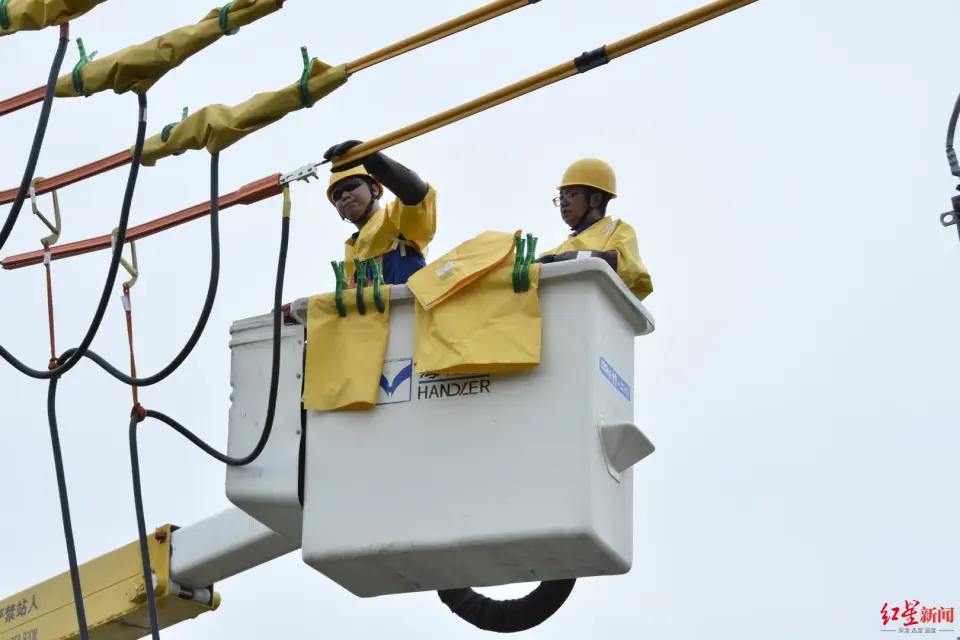
Operator: State Grid Chengdu Shuangliu Supply Company Location: Dajing Community, Jiujiang Street, Shuangliu District Original transformer: 50 kVA (oil-immersed, pole-mounted, in overloaded and leaking condition) Replacement transformer: 200 kVA Customers served: 100+ residential households Operation duration: Not reported Significance: First implementation of this technique by any district-level grid company in Sichuan Province

This case was notable for combining a genuine emergency condition — the original transformer had developed an oil leak due to sustained overloading and required urgent replacement — with a zero-downtime methodology. Rather than accept the inevitable outage that a conventional emergency replacement would have produced, the Shuangliu team deployed the mobile substation bypass approach.

The project was coordinated across three work groups: the live-line crew, the conventional maintenance crew, and the local supply station team.


Case 3 — Wuxi Economic Development Zone, Jiangsu Province (March 2023)
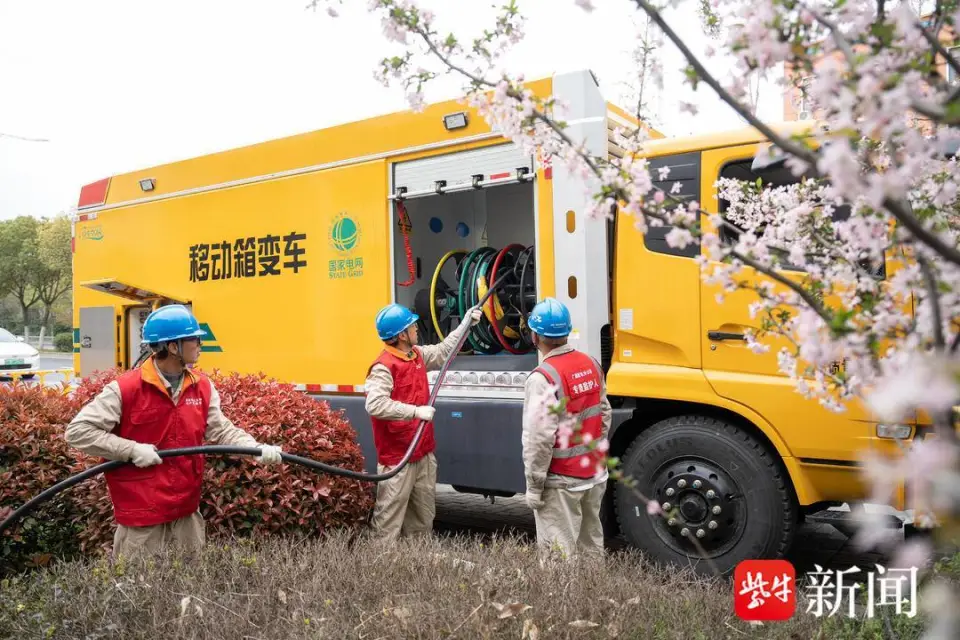
Operator: State Grid Wuxi Supply Company, No-Outage Operations Centre Location: Fenghua Line No. 21, Songxing Electronics Transformer Bay, Wuxi Economic Development Zone Network voltage: 20 kV (non-standard; most Chinese distribution networks operate at 10 kV) Customers affected if stopped: Industrial park including Japanese-owned electronics manufacturers, medical device manufacturers, 50+ additional users Operation duration: 5 hours Significance: First documented use of a 20 kV-capable mobile box-type substation in China; unit developed in-house by State Grid Wuxi

This case is technically the most complex of the five. The transformer bay operated at 20 kV rather than the standard 10 kV used across most of the Chinese distribution network. No commercially available mobile substation at the time was capable of operating at this voltage. The Wuxi No-Outage Operations Centre developed a purpose-built mobile unit with 20 kV / 10 kV intelligent switchable HV input and a 0.4 kV to 10 kV / 20 kV boost capability — described at the time as a domestic first.

The industrial park served included precision electronics manufacturers for whom even a brief interruption would have caused production disruption and potential equipment damage.

Insulated bucket truck operator isolating original transformer under live-line conditions — 20kV mobile substation operation, Wuxi Jiangsu 2023
An operator working from an insulated aerial platform isolates the original transformer from the energized 20 kV network. This step — performed while the mobile substation carries the full load — marks the transition from Phase 2 to Phase 3 of the live replacement sequence. Wuxi Economic Development Zone, Jiangsu, March 2023.
Crew deploying flexible cables to mobile box-type substation vehicle — industrial zone live transformer replacement, Wuxi Jiangsu 2023
Ground crew deploying flexible cables connecting the mobile box-type substation to the 20 kV distribution network. The work site in the Wuxi Economic Development Zone included additional routing challenges: HV cable had to be routed through low vegetation that required clearing and protection with waterproof sheeting. Wuxi, Jiangsu, March 2023.

Case 4 — Yongding District, Fujian Province (April 2024)
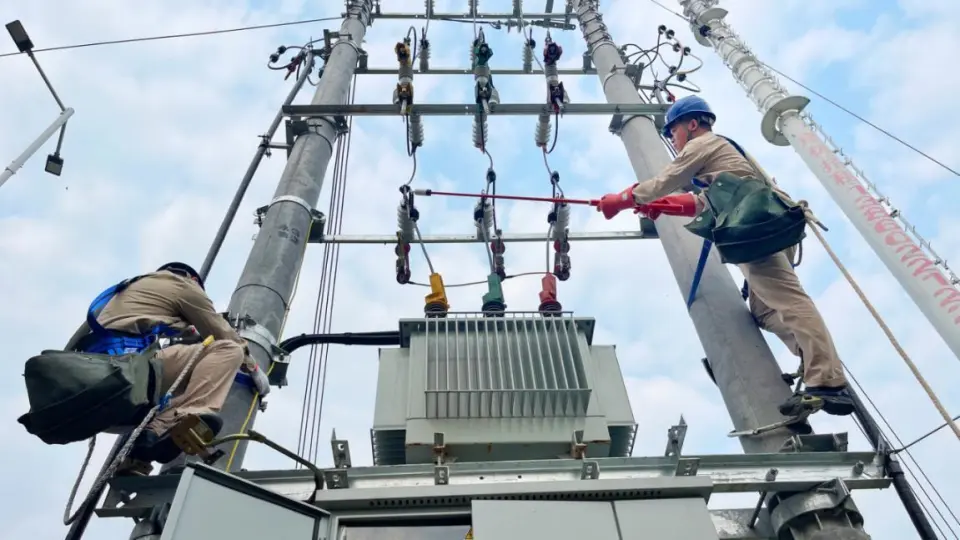
Operator: State Grid Yongding District Supply Company Location: Shuanggu Road, Sanfeng Village, Chengjiao Town, Yongding District Original transformer: 200 kVA (10 kV, pole-mounted on double-pole structure) Replacement transformer: 400 kVA Customers served: 100+ residential households Operation duration: 5+ hours Significance: First implementation in Yongding District

The Yongding case is notable for the physical complexity of the installation. The original transformer was mounted on a double-pole structure — a heavier mounting arrangement requiring a larger crane radius and more precise lifts than a single-pole installation. The new 400 kVA oil-immersed unit was transported to site on a dedicated flatbed vehicle and lifted directly to the mounting height.

The entire bypass supply period — from the moment the original transformer was isolated to the moment the new unit was energized and the mobile substation withdrawn — was approximately five hours.

Crew member inspecting cable connection interfaces on mobile box-type substation vehicle — Yongding District Fujian live replacement 2024
A crew member checks the cable connection interfaces on the mobile box-type substation vehicle before energization. Thorough inspection of all connection points is a mandatory step before the mobile unit is brought into parallel operation with the live network. Yongding District, Fujian Province, April 2024.
Crane lifting new oil-immersed distribution transformer from transport flatbed — live replacement operation, Yongding District Fujian 2024
The new 400 kVA oil-immersed transformer is lifted from its transport flatbed for installation. The mobile box-type substation continues to supply all 100+ connected households throughout the lift and installation sequence. Yongding District, Fujian Province, April 2024.
New oil-immersed transformer being positioned onto double-pole mounting structure — zero-downtime replacement, Yongding Fujian April 2024
The new 400 kVA oil-immersed transformer is guided into position on the double-pole mounting structure. The use of a double-pole configuration — which supports heavier transformers than a single pole — required precise crane positioning to achieve clearance from the adjacent live conductors. Yongding District, Fujian Province, April 2024.
Crew checking energization status of newly installed transformer — final phase of zero-downtime replacement, Yongding Fujian 2024
With the new transformer installed and connected, crew members verify energization and check operational status before the mobile substation is withdrawn from the network. This inspection confirms that the new unit is carrying load correctly before the temporary bypass supply is removed. Yongding District, Fujian Province, April 2024.
Four-vehicle site overview of completed live transformer replacement — mobile substation, crane, transformer transport, and bucket truck, Yongding Fujian 2024
Full site overview of the completed live transformer replacement operation at Yongding District, showing the four-vehicle deployment: mobile box-type substation vehicle, transformer crane, transformer transport flatbed, and insulated aerial work platform truck. Yongding District, Fujian Province, April 2024.

Case 5 — Qianyang County, Baoji, Shaanxi Province (April 2026)
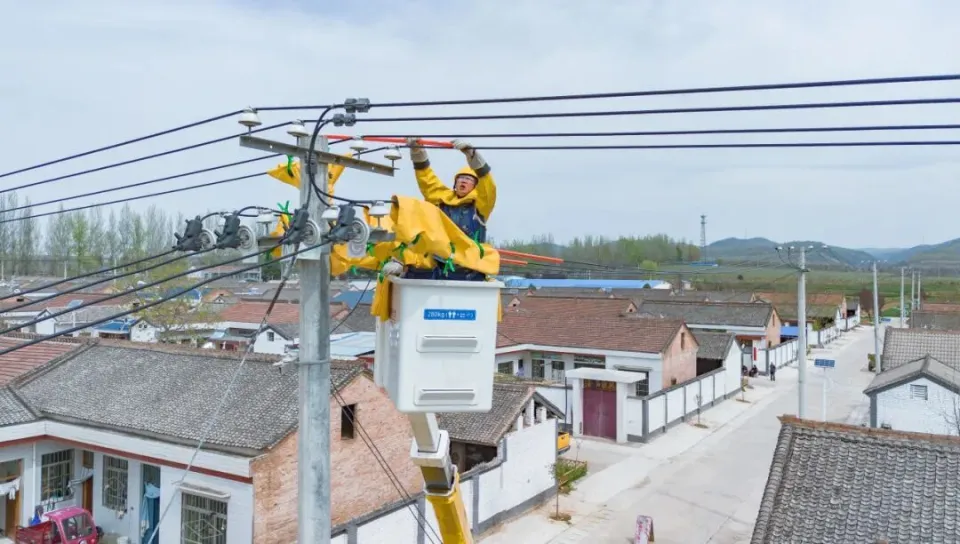
Operator: State Grid Baoji Supply Company / State Grid Qianyang County Supply Company Location: Zhangjiatian Town, Qianyang County Original transformer: 100 kVA Replacement transformer: 200 kVA Customers served: 104 residential households Operation duration: ~8 hours (09:30 to 17:00) Significance: First implementation by State Grid Baoji Supply Company

This is the most recent of the five cases and introduces a specific technical refinement: rather than a simple parallel supply arrangement, the Baoji implementation used a synchronization device to manage the parallel connection of the generator vehicle with the grid supply. The synchronization device automatically verifies that phase sequence, voltage, frequency, and phase angle are within acceptable limits before closing the parallel connection — eliminating the risk of out-of-phase switching transients that could otherwise affect sensitive loads.

The case also represents a multi-discipline coordination: live HV line work, live LV work, and conventional ground operations running simultaneously across separate crews.

Equipment Requirements: What This Operation Needs

Every one of the five cases above required the same three categories of specialist vehicle on site:

1. Mobile Box-Type Substation Vehicle The central piece of equipment. A complete distribution transformer and associated MV/LV switchgear, mounted on a road-going vehicle chassis with flexible HV and LV cable connections. Operating voltage is typically 10 kV input / 0.4 kV output for standard distribution network work. The Wuxi case required a purpose-built unit capable of 20 kV input. Rated transformer capacity must be sufficient to carry the full load of the circuit being bypassed.

2. Insulated Aerial Work Platform (Insulated Bucket Truck) Required for all live-line connection work at the overhead conductors. Provides a fully insulated working platform that allows operators to work at distribution line height under energized conditions. Typically two units are deployed on larger operations to allow simultaneous work at both the HV and LV connection points.

3. Crane Vehicle Required for the physical removal of the old transformer and the installation of the new unit. Pole-mounted distribution transformers in the 100–400 kVA range typically weigh between 400 and 1,200 kg. A dedicated crane is essential; the geometry of a live overhead network does not allow the use of improvised lifting arrangements.

In the Yongding case, a fourth vehicle — a flatbed transport for the new transformer — was also present on site, bringing the total specialist vehicle count to four.

What This Means for Transformer Procurement

The adoption of live replacement methodology has a direct implication for transformer specifications. When the possibility of a zero-downtime replacement is on the table, the constraints that have historically forced operators to accept oversized transformers as a hedge against future planned outages are relaxed. Capacity upgrades can be carried out more frequently and in smaller increments, since each upgrade no longer carries the cost and disruption of a planned outage.

From a procurement perspective, this creates demand for a broader range of transformer ratings — particularly in the 200–630 kVA range where incremental capacity upgrades are most common — and for transformers that are compatible with the connection interfaces used by mobile substation equipment.

Conclusion

The zero-downtime transformer replacement method documented here is not experimental. It has been implemented by multiple State Grid subsidiary companies across China, at different network voltages, in residential, industrial, and mixed-use supply contexts. The technique is spreading because the economics are compelling: the cost of deploying specialist equipment for a few hours is substantially lower than the cost of a planned outage for most commercial and industrial customers.

The key enabler is the mobile box-type substation — a piece of equipment that the electrical industry has had available for decades, now being applied in a systematic way to one of distribution grid maintenance’s most disruptive routine tasks.

What this method does not require is any special modification to the permanent transformer being installed. The distribution transformer at the centre of the operation — whether oil-immersed or dry-type, whether 100 kVA or 630 kVA — is a standard unit. What changes is the operational context it enters: it must be ready to energise cleanly into a network that has been live throughout the replacement window, often within a tight physical envelope and on a schedule driven by the mobile substation’s available supply hours.

That operational context is increasingly the normal context. As live replacement methodology spreads through China’s distribution grid and begins to appear in international markets, the manufacturers who understand it — and who build transformers and mobile substation equipment to the connection interfaces and reliability standards it demands — are the ones who will be specified into these projects.

Zhongxin General (Sichuan Zhongxin General Electric Energy Co., Ltd.) manufactures oil-immersed and dry-type distribution transformers across the full range of ratings used in the cases documented here, from 100 kVA to well above 400 kVA, at standard 10 kV and non-standard voltage levels. Our prefabricated box-type substation products include mobile and transportable configurations suitable for use as temporary bypass supply in live replacement operations. For project enquiries, contact us via the form below or on WhatsApp.

Kevin Z

About the Author

Kevin Z

Kevin Z

About the Author

Kevin Z

Kevin holds dual academic backgrounds in Electrical Engineering and English Language. He is a core member of two selective professional communities — a group of elite electrical engineers and a high-level ESL learning circle. With over 15 years of experience in international marketing and sales, Kevin currently serves as Director of International Trade at Zhongxin General.

Beyond his corporate role, Kevin is also a key member of a distinguished export business network based in Ningbo, Zhejiang — one of China’s most dynamic trade hubs. Through this circle of outstanding export enterprises, he gains deep exposure to best practices in business operations, management strategies, and global trade — insights he brings directly to his work and writing. Get in touch with Kevin by [email protected]

Four-vehicle site overview of completed live transformer replacement — mobile substation, crane, transformer transport, and bucket truck, Yongding Fujian 2024

Live Transformer Replacement Using Mobile Box Type Substations: How China’s Utilities Achieve Zero Downtime

China’s grid operators have quietly mastered a technique that eliminates the traditional 4–6 hour blackout when replacing a distribution transformer. Using a mobile box-type substation as a temporary bypass supply, crews can swap out an old unit while connected customers experience zero interruption. This article explains the method, the specialist vehicles involved, and documents five real-world cases carried out across China between 2020 and 2026.

Read More »
First prefabricated box substation loaded on truck at Zhongxin General factory gate — PetroChina Luntai Tarim oilfield Xinjiang April 2026

3× Prefabricated Box-Type Substations Delivered to PetroChina Luntai Project — Tarim Oilfield, Xinjiang

On April 17, 2026, Zhongxin General dispatched three prefabricated box-type substations to PetroChina’s Luntai County project in Xinjiang — serving the Tarim oilfield core zone for oilfield production expansion, photovoltaic grid connection, and industrial load supply. Each unit contains a 2500kVA SCB14 Grade 2 dry-type transformer (10kV/0.4kV) and a 2500kVA Grade 2 oil-immersed transformer (35kV/10kV), with IP54 protection, seismic Grade 9 design, and -30°C to +55°C operating range for Xinjiang’s desert environment.

Read More »
Transport truck weatherproof covers secured ready to depart — Zhongxin General Nepal Chino Hydropower Station April 17 2026

5000kVA 33kV Hydropower Station Transformer Exported to Nepal — Chino Hydropower Project

On April 17, 2026, Zhongxin General dispatched two S-5000/33GY oil-immersed step-up transformers (5,000 kVA, 33kV/6.3kV, YNd11, ONAN) and a complete switchgear package to Nepal’s Chino Hydropower Station — a 7.9 MW run-of-river project in Manang District, Gandaki Province, with annual generation capacity of 44.38 GWh. Shipped overland with an estimated six-day transit to the China-Nepal border crossing. Full technical specifications, factory acceptance testing, and dispatch photos included.

Read More »
Aerial panoramic view of Three Gorges Dam across full width with Yangtze River reservoir and upstream city visible in background

How Chongqing Won the Three Gorges Large Transformer Project: A First-Hand Account

In 1993, China’s decision to build the Three Gorges Dam triggered an unexpected competition: which city would manufacture the world’s largest power transformers — units weighing 400 tonnes each, at a voltage class no Chinese factory had ever achieved? This is the first-hand account of how Chongqing won that contest, told by the municipal planning official who led the effort.

Read More »
Aerial panoramic view of TBEA‘s Changji headquarters and technology R&D base in Xinjiang, China, 2023, featuring the UHV transformer engineering research center and science and technology industrial park

From a Street Repair Shop to the World‘s UHV Transformer Leader: The TBEA Story

In 1988, a 26-year-old technician took over a debt-ridden street transformer repair shop in Xinjiang with 53 employees and no hope. Today, that company is TBEA — the world’s largest transformer manufacturer by capacity and the only one with mass production capability of ±1100kV UHV DC technology. This is the amazing story of how one man’s choice and a series of bold acquisitions built China’s transformer champion.

Read More »
16,000 kVA 35kV OLTC transformer loaded on heavy transport truck — view from workshop toward factory gate, Zhongxin General April 2026

16,000 kVA OLTC Oil Immersed Transformer 35kV/10.5kV

On April 11, 2026, Zhongxin General completed delivery of one 16,000 kVA on-load tap-changing oil-immersed transformer to a dedicated 35kV industrial zone substation. This unit will serve as the main step-down transformer for the entire zone, taking dedicated 35kV incoming power and stepping it down to 10.5kV for zone-wide distribution. This case study documents the complete production process from core stacking through factory acceptance testing to dispatch

Read More »

Get In Touch Now

Thanks for leaving message to us, in workdays your message will be replied in 24 hours. Please be specific on your needs, so we can reply targetedly. 

Send a Message to Us

Thanks for leaving a message to us, we will reply as soon as possible! The more detailed your message is, the more targeted reply we will make!

Get In Touch Now

Thank you for leaving message to us, the more specific and detailed your message is, the more targeted reply you will receive, your message usually will be replied within 24 hours!